Wednesday, September 10, 2014

Explaining Stock Market using Behavioral Economics: Level of Resistance and Level of Support. Seriously, how do they work!?? (revised)

**Note1: For those who don't like to read long article, you can skip the first several paragraphs. Scroll down a bit, and jump to the text below the line. I clearly mark it for you. 

**Note2: However, the first several paragraphs do introduce you to a bit of new knowledge as well. If you have time, read them all. 

**Note3: I want to let you know that though I did some research before I wrote, my explanation is purely based on my thinking and the knowledge I have so far. So do not use this as a reference, unless it really convinces you that this article makes a lot of sense. 
------------------------------------------------------------------------------------------------------------------------

I have been thinking of trying to post something new and refreshing to give a bit of breadth to the blog... and voila, there you have it. Today, I was doing some reading, and I came across the terms: "level of resistance" and "level of support" used in trading stock and forex. I do not know if these 2 terms are broadly used in any other types of trading like trading securities in general. That does not matter anyway.

Just a bit of additional info before we start. What are securities? By definition, securities are divided into debt securities and equities. Trading debt securities is none other than trading debt. An example of a debt security would be Bonds, like government and corporate bonds. In contrast, equities represent ownership of assets. Example? Stock, and that is what I am going to talk about today.

Our discussion will be related to stock market, but I am not trying to teach you about how to trade or how to make millions of dollars. If you read this article hoping to make some bucks, then the exit is right there. 

I mean, come on, I, myself, have not even bought or sold any stock once in my life. How can I provide you with the million-dollar tips? Plus, I am a risk-averse person, probably because I have no money, which make any financial loss a huge deal for me. However, I have a decreasing absolute risk aversion trait. What does that mean? That means as I am getting richer, I will become less risk averse, and thus, the amount of wealth I am willing to expose to risk will increase. When that time comes, hopefully, sooner rather than later, I will give it a shot.

Neither am I going to explain you about stock, about stuff like long/short position... okay, may be a bit about the long/short jargon. Nothing much, really. Long means buy. Short means sell. Think of it this way; you have a line of cookies, and when it is getting shorter, then means you have sold some cookies to someone else. By the same token, when it gets longer, that means you have bought some cookies to include in your collection, the long line of cookies in your kitchen. Simple, but not 100% correct. There are more to long/short stock. They are not simply buy and sell, but buy and sell are close enough for the purpose of this article. For more information (if you are curious), please google them.

As you can see, I am not here to teach you Finance 101. I am here to talk about how the level of resistance and level of support are what they are, and why they have been used widely despite the lack of explanation. The thing is I have been going around trying to find a good explanation of why and how those two work, but sadly, I could not find any good sources on the web that provide a clear rationale of what is going on behind the scene (maybe, you can. Give it a try!). I can just imagine the frustration of students trying to digest this knowledge while having little idea of how it works and why it is there.

So, I am going to explain them by myself, using economics or just common sense. There is no secret to it. Things are the way they are because of a reason or two. 

Enough chitchatting, let's get into business.

----------------------------------------------------------------------------------------------------------------------
**The real stuff begins here:

Before we begin, I want to introduce three important elements I am using today to make some sense of the stock shenanigans. (Note: There is not point in using the word "shenanigans" here. It is not even relevant. However, I just think it sounds cool and what to put it somewhere in the text. Try to understand it from the context only, not the exact meaning. lol)

You need to understand three explanatory elements and the definition of the two terms (support and resistance) before we can unravel the mystery. 

First, knowledge of common. What is it? Knowledge of common is common knowledge. I just think it is cooler to use "of". Basically, it is the knowledge shared by either most or all people.

Second, rational expectation. Rational expectation is pretty much what rational people expect to happen as a result of their actions or some uncontrollable exogenous force or shock. Mostly, people use the knowledge they have gained from the various sources such as personal experience, media, books, grapevine and so forth; they then combine the knowledge of the past with the available information of the present to arrive at a final product, the conclusion in the form of expectation, a rational one. Can you see the connection between the first and second elements yet? Get it? People use knowledge to form a rational expectation!

Third, self-fulfilling prophecy. Just a heads up, in case the third element makes you think there is something spiritual about this article, the answer is No. No, There is nothing here for you if you want a fortune-telling. Anyway, self-fulling prophecy is basically a prediction that becomes true because people simply believe the prediction and act accordingly anticipating what foretold to be realized in the future. There are instances in which no matter how ridiculous or baseless the prophecy may sound to the logical thinkers, it can become true with enough people believing in it. That just means being logical is to take this fact into account when engaging in thought. So, can you see how the first, the second, and the third elements are connected yet? People believe in the prophecy (in the form of knowledge), act it out with rational expectation, and the prophecy is actualized!

knowledge of common, rational expectation, and self-fulling prophecy. We will use these three to explain level of resistance and level of support. However, to explain how and why they happen, I need to first clearly define the two financial terminologies.
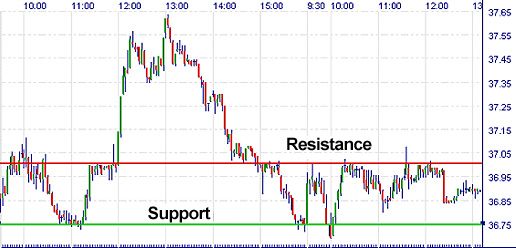

Image source: http://www.tradingacademy.com/assets/images/fec/supportresistance1.jpg


The picture above will act as an illustration to aid your learning of the concept. They might look simple, but their inherent complexity is undeniable, even to the experienced traders. Let's not make life any harder that it is. There are simple definitions too.

Just like the picture shows, the level of support is a line, a price level, which stock price seems to have difficulty falling below. You will see that the price was pushed down several times, but it could not go lower than the level of support.

On the contrary, level of resistance is the price line, the price ceiling that stock price cannot seem to break through. As you can see in the picture, the price, most of the time, could not increase any further once it reaches the red line, and the fluctuation, most of the time, is within the band of the support line and the resistance line.

This concept is most useful in short-term trading. Why is that? Because short-term trading is influenced more by the profit-seeking behavior of individual traders who do short-term speculation based on their instinct or belief of when and at what point to buy and to sell. Unlike long-term trend, short-term trend is unlikely to be affected by real variables like exogenous (or external) economic shock, new innovation, new products or services, government policies, or any changes in the actual operation of a firm or the whole industry or the business environment. It is based mostly on the animal spirit of the people. That is, by my own definition, what short-term trading is, and this is when level of support and level of resistance work best.

So what does this tell you? It tells you that there are a lot of psychological factors coming into play here, and what I am doing now is using behavioral economics to explain why resistance and support lines exist. (Behavioral economics can be simply regarded as a branch of economics that studies human behaviour and how that influences their individual economic decision and the collective economy)

First of all, we have to understand that short-term traders are always interested in understanding the tools, the concepts to give them the edge in trading. Once level of support and level of resistance have been introduced, once the terms have been coined, people become curious and they study and study to absorb this new knowledge. Sooner or later, the concept becomes a common knowledge for the mass. This particular topic will be everywhere in school, in finance class, and people become more and more acquainted with it, more convinced that support and resistance lines actually work. Once enough people, whether or not they understand the underlying reasons, believe in support and resistance lines, this new knowledge will then become the knowledge of common.

This is when rational expectation comes into play. As you may have guessed, traders are rational people. Well, most profit-seeking individuals are rational. They make rational decision to arrive at a logical conclusion based on what they know, on the information they possess to speculate the future. You will see what I mean by "rational expectation". Keep reading.

Based on the past low stock price and its persistence to fall below that low mark, people start to draw a line and they call it support line. So when a large number of people expect that price will not fall below support line, they will want to buy stock at this point hoping to gain from the imminent increase in price. Voila, now everyone buys stock based on the expectation they form rationally. What does economics tell you? Buy = Demand. People demand more stock at the point of support line, and consequently, the price rises! This pattern repeats itself again and again a few times or many times, leading to what we call "the level of support". In the end, price really does not fall below the support line because people keep buying more stocks pushing the price up as it nearly reaches the support line.

This is what I mean by self-fulling prophecy. Enough people believe that price will not fall below the limit that they draw, they act it out as any rational being would, and due to this reason, price does not fall below the level of support. This further reassures people that level of support does work! So they continue to repeat and the result repeats itself as well.

Same goes for the line of resistance. Same process; knowledge of common and rational expectation lead to self-fulfilling prophecy. Enough people believe that price will not go beyond the resistance line. They start selling when price comes close to the line to gain the maximum profit because they know that price will soon fall. Again, what does economics tell you? Sell = Supply. As people sell their stock, the company's stocks pile up due to sudden increase in supply, and price simply falls as a result.

In the long run, however, stock price will follow the changes in the real-world variables. For instance, just like when Apple announces its new products, and its shareholders start to buy more stock due to their strong faith in the company believing its new products will bring Apple much more success as a company, and thus, a greater return for its shareholders. That is why we see either upward trend or downward trend of a company's stocks. This is one way to break through the support or resistance line.

And that's a wrap. I hope you enjoy reading and ingesting new knowledge just like how I enjoy writing this article. It is just refreshing being able to write something new once in a while.

Until next time,


Friday, August 15, 2014

Market Failure: The Flaws of Capitalism and Laissez Faire Economics

SOME CHANGES MADE~!
----------------------------------------------------------------
16-08-2014
**Some mistakes spotted as I re-read the article. I will revise them later to create a better flow, make the article more reader friendly and not causing much confusion.**

----------------------------------------------------------------
Contents as of 29-08-2014:

My apology. As stated above, I noticed some mistakes. Well, not mistakes in a strict sense, but more like something that can potentially cause confusion. I have just realized that I really need to insert this paragraph somewhere in the text, and no where can I fit it in better than at the beginning of the article.

So let me clarify one thing. I want to make it clear to all of you of there. Long story short, capitalism is about private ownership. Free market is about the freedom in exchanging of goods and services. Simply speaking, capitalism is accumulating privately-owned wealth, while free market or laissez faire economics is about freely trading your wealth after having it converted into something tradable. The two are entwined and quite often got mixed up. While free market requires capitalism to operate effectively and efficiently, capitalism does not necessarily need free market. In fact, in extreme case, capitalism can also exist in the absence of free market (like when only monopoly exists, what is monopoly? Google it). For simplicity, the article does not differentiate much between the two. Most of the time, you will see either term used in the same paragraph. Do not freak out! Despite the difference, the consequences resulted from having both or either one of the two (capitalism or free market) freely reign an economy are quite similar. At least, that is what I think!

From my very first article, little did I write in favor government intervention or restriction on the free market system. It seems as if I am in full support of an economy with no or little government intervention. And that is not the case actually. In economics, we have something called "Market Failure". Market Failure is neither a myth nor an attempt of a government to gain more power. Market Failure is real, and it is pretty much related to Capitalism and Laissez Faire Economics.

In essence, capitalism is a key component of free market, and capitalism is to allow people to pursue their dream, prioritize their self-interest, and optimize the use of their resources to attain the best possible outcome and maximum profit. We can also say that the many individual quests to accumulate wealth, combined, have given birth to capitalism, and the economic system that allows everyone to do so, or to be accurate, that enhances the effectiveness of capitalism and directs it towards the optimal path for the mass is the one that favors free market system with little or without exertion of force or control is called Laissez Faire Economics.

Being free is good. People fight for freedom. They want to liberate themselves from all sorts of bondage. This is human nature, to be free because YOLO, you only live once. However, note that in theory, we mostly talk about economic freedom in its perfect form, we always talk about the extreme of this or that because it is just much easier to imagine and study, and much less complex to analyze as it gets rid of the myriads of other influential variables that increase uncertainty and unpredictability. The real world is not as simple, and for this reason, free market cannot and should not exist on its own. I will explain why later in the article.

Capitalism promotes free market which is believed to give birth to all sorts of great incentives for the people to work their buttS off because in capitalism, your get to reap what you sow. You speculate well, you seize the right opportunity at the right time, you invent and innovate, you add much brain power, energy and time as inputs, and the final product is yours to sell to the world. Your increased productivity drives the world economy forward. You work for yourself, but to increase your productivity, you hire people, i.e. pay them, to work for you. In that sense, everyone is better off! A single person's initiation, his spirit of entrepreneurship to create something of value from which he can derive profit, will, whether or not that is his aim, benefit the world and the society around him. Those beneficiaries are called stakeholders, and who are they? They are employees, suppliers, buyers, society in which the business operates, and also the international community as well.

As mentioned, the great thing about free market is that a single person's greed is turned into everyone's benefits. The desire to produce to earn, the desire to beat your competitors by cutting cost, reinventing the wheel, giving birth to new invention and innovation, improving existing products and services... all result in betterment of human living standard as witnessed during the last couple of centuries. Nothing, nothing but capitalism/free market will ever respond so quickly to the new demand, want or need of consumers. Why? Because the ambitious ones always seek the gap that must be filled within a market. Businessmen respond and adapt quickly to the changes in market conditions, much faster than the government ever could, because they are the frontline soldiers, they have the expertise in their own respective fields of production, they know the drill, and the most important of all, they seek profit, and capitalism gives them the enabling environment to do so.

HOWEVER, wait for it...

TOO MUCH of anything is NEVER GOOD. Too much cake will make you fat, too much nightclub will make you bad, and too much study will make you sad. Like wise, too much of free market will corrupt the economy. Capitalism is good because the complex economic system turns self-interest into collective yields. Nonetheless, this simple reasoning that justifies the use of laissez faire economics was contested. Many times. And is still going on. And on. And on.

The challenger based their opposition to the free market on the so-called Market Failure, the Flaws of Capitalism and Laissez Faire Economics. Though much is true that free market has been good (or so we think) to us for many decades, leading to double-digit economic growth for nations like China for many years, capitalism still has its engine sparked and run by profit-seeking individuals who probably do not think much of the well-being of the rest of the world. Of course, somehow, free market dictates that their actions will keep the globe spun and everyone gets a piece of the sweetness. However, the greed driven behavior will make the system implode. You will see why soon.

Capitalism/free market often does not lead to Pareto Efficiency or Pareto Optimality, an economic state where every individual well-being can no longer be optimized without causing harm in some sort of form to the others. The problem is that Capitalism/Free market will continue to drive the economy onwards even the cost to the society at large outweighs the profit to a small number of individuals, and no matter how much return certain actions will yield to the collective social welfare, capitalism fails to make them happen if the individual benefit is not there. This statement I made, I think (and if I am correct), pretty much sums up everything of the defects of capitalism. Simply put, social cost is just too great that the individual benefits yielded by an action (say a business action) is insignificant, and this leads to inefficiency or waste or huge opportunity cost.

I will give you more specific examples on the matter.

Let's us now look at market failure from a few different angles.

The first thing that comes to my mind when thinking about market failure is none other than Externalities. What are they? They are the by-products resulted before, during or after a business action that may either of beneficial or harmful effects for the people in general, not limited to the direct stakeholders. Now, let's focus on negative externalities so we can challenge the concept of free market. These are mostly unintended or perversely done so despite knowing the demerits. For instance, the severe environmental damage set in by the Chinese manufacturers in a number of regions in China, the burning forest in Indonesia leading to negative health impacts on countries like Singapore and so forth. These are all decisions made by profit-seeking individuals who may or may not have carefully studied the repercussion of their actions, and they ended up harming the communities or societies, even the ones of great distant from them.

Let's try to relate this to individual rationality and collective irrationality, the past article of this blog. I will give you an example. You see, when free market rules, individuals will exert their utmost effort to meet their own best vested interest, even in something some people consider trivial like driving. Everyone is pushing forward for the little available space on the lane so they can arrive at their destination a bit faster, and this is actually a very rational and free-market-like decision. What is the result? Traffic congestion. If the rule of getting in the line/queue was not firmly established and enforced, the result is traffic congestion. Smoking is also another example. Smoking is bad for the smokers, and well, these are individual choice knowing well that they are exchanging some of their own life span for those moments of transient pleasure. By the laws of free-market and freedom of choice, this should be okay. However, their decision introduces negative externality, smoke that is a threat to the health of the people around them. So now, we have smoke-free laws.

Talk about smoking, let us now get into de-merit goods and services. De-merit goods and services are those goods and services that despite their demand on the market, they are harmful in some way to all or certain segments of the population. Like? Like Cigarette or Alcohol or Drug. Without regulations and taxes placed on these goods, who knows what our world will turn into? These are why we have the no-drink-while-driving laws and such. It is of crucial importance to realize that certain limitation need to be in place for the market to function as it should.

How about public goods? Let us first define public goods. What are they? Well, they have 3 characteristics, but sadly, I only remember two, and googling or yahoo-ing or binging doesn't seem to help either. Actually, during my study, my prof specifically said that pure public goods are hard to come across or think of. Well, for simplicity, let's just say that public goods are the one that are non-rivalrous and non-excludable. Non-rivalrous goods are those which are not depletable. In other words, if you think of Hamburger as a public goods, then no matter how much group A consumes it, it will never exhaust the supply of Hamburger for group B. Non-excludable goods are those that everyone can consume, everyone can utilize. For instance, you cannot ban a person from enjoying the beautiful sunset or listen to free music played by some street bands. You cannot ban a person from fishing, but the more he fishes, the less fish there will be for the rest of the world. This is why we have fishing license and regulation! Come to think of it, maybe air is a pure public goods... I think.. not sure though. Don't take my words for it.

Anyway, when we talk about public goods, we are talking about the missing market that might as well be non-existent or insufficient to meet the people's demand when free market is allowed to reign a nation. What might those be? For instance, street light, national defense, highway and such. Why is that? Because of the "free-rider" problem. In other word, the moment you produces street light or something as big as national defense, you cannot exclude any citizen of a country from benefiting from it simply because he/she doesn't pay for it. National defense is for the whole nation, and if it was produced in a free-market, some people might refuse to pay for it, and this is a problem because the less you pay, the less you have to sustain the national defense. That is why we have the tax system, the tax laws that requires everyone to pay taxes. This is only made possible by an entity considered as the locomotive of the nation, the government. Not just national defense or street light, even education or health which is not a complete public goods might not be made enough to meet the demand under the free-market if the government does not intervene.

And do you think that the many transactions happening even as we speak can continue so smoothly without the laws and regulations to govern them? No. Of course not. This is partly due to the asymmetric information. In a transaction, it is not in their best interest for the sellers or sometimes also the buyers to disclose all the information (including intention and motive) they have available for the products or services. This is why we have the judicial branch to take care of things like fraudulence.

Last but not least (though there are so much more to talk about), I want to talk about income inequality. Free market is more likely to expand the gap of income than shrinking them. Free market does not stop the rich from accumulating more and more wealth (even some are doing it through the means of exploitation in various forms). Though this might sound negative, what I really meant is that free market won't stop rewarding you or reward you less for your success. It will keep doing so, and eventually, there will be a small bunch of people with great wealth and power while the majority will be in the range between middle-income and low-income. Many examples can be seen throughout the history of human kind, and like it or not, income inequality can lead to social unrest and revolution. Violent or not, the restructuring of the economic system through such means will drastically damage the economy as it upsets the balance of wealth and power once so familiar to the people. Income inequality, at its worst, can lead to what I would like to call "relative poor" portion of the population. This is a social problem. The relative poor is the one who is not exactly poor, by strict definition, but still thinks that he/she is poor when comparing to the richer few. This has a lot to do with the psychological phenomena which I am not knowledgeable enough to elaborate.

Well, this is a pretty long article, and I will end it here for the sake of saving you from boredom. This is not the end of it, and there are so much more to write. As you may have noticed, I really did not get into detail (which would only make it much longer). To sum up, what I want to convey to you, my dear reader, is that there is nothing that is good when taking to the extreme. Moderation is the key. It is easier talked than done, or in my case, written than done. When you talk about moderation, people ask "but to what extent? What is the appropriate degree of moderation?", well folks, this is a complicated question. Moderation cannot be perfectly executed because, easy answer, there is no perfection in this world, and to answer it in a bit more complicated way... the world, as we know it, is made of so many variables as the factors that influence an economy; by this rationale, in order to balance between free-market and central planning, we need to first gather data, analyse, see the pattern, see the trend, observe the reality, understand factors of production, conduct speculation, and do cross-sectoral meeting to discuss about the possible impacts of certain decisions to be made for the whole nation. One thing for sure is that a great economist must be present in order to coordinate and direct the process. A good decision can result in a leap-forward for an economy while a bad one can also result in a leap-backward or the lost of potential (huge opportunity cost) for an economy. So balancing and moderation are important, and... to be continued.

That's it for now. We will meet in our next article.

Thursday, August 7, 2014

Free Market and its Self-Correcting System: A glimpse at Income Effect and Substitution Effect (Featuring Zombies)

In economics, nothing is more fun than observing words and thought of economists being animated in the real world, our everyday life. One of the earliest economic concepts I came across was none other than income effect and substitution effect, the two popular terms which every economist is so fond of. They are very simple and easy-to-digest concepts, to be honest.

Income effect basically states that the more you earn or the more income you generate, the more you consume. For example, assuming you really like cake. When you earn $1000/month, you can only buy 1 cake/week. That is the budget cap because you need to spend your money on other necessities like utilities (water, electricity, internet...), healthy food, gas for your car, etc. But once you get promoted to a much much higher position and end up earning $10,000/month? Your entire house rains cake. You might even buy a fridge solely dedicated to storing cake. You will get really fat and have a stroke from all the cake you consume.

Substitution effect, on the other hand, focuses on the change in price and change in consumption pattern, or simply put, the higher the price of a certain product, the more likely you are to consume none or less of them and switch to purchasing their substitutes, if there is any; and the reverse is also true. For example, let's say you are the same person who likes cake to the point that you can die for it, literally. Suddenly, without any warning, World War Z happens. Zombies apocalypse befalls your country (but for some unknown and inexplicable reason, it is a special type of zombies in a way that they are only attracted to cakes and bakers in your country...), and so, all the bakers in your country have been, unfortunately, turned into zombies. And for some other unknown reason, your company is still running and you still get paid $10,000/month (because I say so). Well, the crisis your country faces now is severe cake shortage (Of course, let's just ignore all the zombies that are running around. No one cares about them). Wait, I should have mentioned also that every other country puts up huge and impregnable walls, blocking the way of anyone, let alone zombies, that can inflict even the slightest injury on their bakers. So yes, you can still get the cake you love so much by importing it. If you really want to eat cake, you need to talk to the importers who will have to risk their life to import the cake from the neighboring countries. A cake now will costs you $9,000 (I am just making it up on the spot). So you see the point. You will now consume less cake simply because the domestic market price of the cake has risen up so much due to the cake zombies crisis. And that is Substitution Effect.

All the hassles it takes to get cake might then change you into a new person. You might start to develop a new liking to your new cake's substitute, probably, ice-cream. Sadly, this new favorite will not make you get any thinner than your previous cake-loving self. But at least, it has taught you something about economics, to be specific, substitution effect.

So to you, ice-cream is probably a substitute product. Just like how some people see Pepsi as a substitute to Coke or vice-versa.

With the zombies apocalypse crippling the cake market operation, it negatively affects many cake ingredients suppliers such as flour seller, sugar farmer and so forth. This might force some of them out of business, but don't lose hope because the lower demand for sugar in the cake industry will push sugar price down, NOT out of the market, yet. Instead, the economy will re-adjust itself. Lower price of sugar will enable more ice-cream makers to make cheaper ice-cream, and thus, increase the demand for ice-cream and expand ice-cream industry.

At the same time, I forgot to mention earlier that along with substitute products, we also have something called complementary products. Assuming cake is just so expensive, so unaffordable that the whole country is now starting to consume more ice-cream as a replacement and coming to like it. As ice-cream becomes more popular, there are bound to be some products that also tag along in this growth spurt. For example, cookies! Some people like to have their ice-cream with some cookies as their side dish. So when the demand for ice-cream rises, cookies business is also doing great, much better than when people were stuffing their face with cake. In this scenario, cookies represent a complementary product because the demand for cookies and the demand for ice-cream are positively correlated. In other words, when people consume more (or less) ice-cream, they also consume more (or less) cookies.

The interesting part is that even if the economy is to be extensively damaged by zombies invasion (causing unemployment, food shortage...), and everyone could barely earn enough income to survive, there are still people who see this as their opportunity to earn money, and thus, introducing a simple economic solution (without knowing it is one), the production of inferior goods.

Inferior goods are those goods that people need more when they become poorer and less when richer (its example is the entire paragraph below). Normal goods is the opposite. Normal goods are something that you consume more as you get richer and less as you get poorer. For example, movies.

Inferior goods are produced within an industry that seeks its profit from people with low income. With rising food price, due to food shortage (substitution effect) and lower income (income effect), people are now facing starvation. So to meet their desperate need for food, people will pretty much consume anything edible (so do the zombies, I guess, but they probably won't pay anyone any money), caring less about the quality of the product. This is when mass production of cheap and low-quality food is hugely rewarding, and those who realize that and dare to follow their ambition to become the richest man in town might start a business that produces inferior goods, for example, instant noodle. People are suffering from zombies attack, the economy crippled, so in time like this, when you can buy your lunch (a pack of instant noodle) for (just an example) $0.25, who wouldn't want it? Assuming the cost to make a pack of noodle is $0.1, so as long as the government doesn't decide to involve itself by, for example, reducing the price even further to, say, $0.09 for a pack of noodle rendering the business unprofitable, then the people can be saved. Believe me, there have been instances that the government did something similar to what I described and ended up starving many people to death (because with $0.09 a pack, no one would be irrational enough to continue producing instant noodle as it might not even cover the cost of doing it).

So what does this tell you about Economics? It tells you about beauty of free market that it allows resource ownership and freedom of choice. Individuals are the one to make their own decision, unlike within a centrally planned economy in which the government or some supreme ruler makes arbitrary decision for the rest of the country (we will discuss more about it in our next article).

Even without much government interference, an economy always has a self-correcting system that allows it to be quite resilient in the face of any foreseen or unforeseen crises. In economics, we have alternative choices; hence, when one door closes, one or many more open. With top-down approach, with too much intervention from the government, there were times when people suffered greatly due to economic hardship (and that is undeniable) as bad economic decisions have led to political turmoil, public outrage, rebellion, war and destruction. Of course, that doesn't mean we need no regulations. Free market is favorable but only with appropriate rules and regulations to level the playing field because sometimes, the self-correcting does not bring us to the state of recovery fast enough (I will talk more about it in our future articles as well). We need people with sufficient knowledge of economics to aid the decision makers. Likewise, we need decision makers who are, at the very least, well-trained in the basics of economics.


Thursday, June 26, 2014

Economic Theories VS Pragmatism

People say that theory is not practical, and that, my friend, is not a criticism, but a truism. Why? Because theory is the production of observation, thought and analysis that will weed out many indirect correlations and emphasize the ones that matter the most to the study and interest. It is not different from learning Taekwondo or Karate or any other martial arts. You have to start from the very basic of the basics. First, you would be taught "Kata" or "Form" of the art, which to beginners are simply dancing around like a fool. You should know you cannot follow each and every step of Kata in real fight. If you do think you can do that, trust me, don't. Kata, I believe, is intended to build within you the foundation of the martial art, its basic forms and nature, so once you are well-acquainted with them, you may then engage in the real action.

Likewise, it is not a surprise that all Economic theories are pretty much taught to you for the same purpose. The more you learn, the more your knowledge base expands, the more flexible you become, the deeper you can think, the more critical thinking you have, the more accurate your deduction becomes. There is no shortcut.

Again and again, I always try to include this in every article, though slightly altered from one to the next, but still convey the same meaning nonetheless that Economics is broad in width and profound in depth. Forgive me if this sounds like I overrate Economics, but as far as I am concerned, the former statement I made is true to its core. 

That is why by the time you have mastered a bunch of the fundamental economic concepts/theories, you will be challenged and haunted by the fact that all of them make sense, but in the real world application, with vast possibilities and unpredictability while the margin of error is never getting any bigger, the likelihood that dependence on an economic theory and/or theories alone to explain and forecast the climate change of the world of economy is unsustainable and inaccurate has always been inducing fear and loss of credibility for the economic discipline again and again for a great number of people. 

However, one must never forget that theories are there to be employed, not solely, but in conjunction with real observation and ongoing analysis of the world, the context. That is why, in the study of economics, reading off your textbooks, attending lecture and listening to your professors are not enough to produce a well-rounded understanding of economics. My advice to you is that once you think you have sufficient knowledge of the text, start looking around for hands-on experience, real time and real world observation, or at least, read reports that convey those experiences to you. Only by then can you be sure of the usefulness of your knowledge. 

If anyone tells you that theories are useless, they probably mean following only the theories you have learnt is stupid. If they mean theories themselves are pointless, those people probably do not have that much understanding of the world of knowledge, the academic realm. 

You must understand that the world has become what it is today thanks to the many theories, not limited to Economics, layer by layer built upon one another, in which the latter is an upgrade of the former. As the pool of knowledge is expanding so is the world evolving to a more complex form. But note that these two, I believe, are strongly correlated. Theories were turned into real practice, and the world evolved as a result, which led to more theories be created, and in turn, resulted in more advanced form of the world. 

For the same reason, economic theories have been extracted from the understanding of the real world, and they have been used extensively in shaping a better world. Their visibility, however, might not be apparent to those who do not seek the knowledge. Regardless, they remains to be a part of the vital force the drives onward the world economy and human well-being. The prosperity you witness today is not just the result of scientific evolution, but also the adoption of an effective and efficient economic system conducive to growth. If you want to know more, why not read more about economics? You will be surprised by how much you do not know, just like I was.

In economic theories, we trust.


Friday, May 16, 2014

Culture and Economics: Looking at Deflation from another corner

**Note: This is a first draft only. I have yet to read through it thoroughly, but I will do. There will be more contents added and mistakes corrected in the 2nd version**

This article will mark my first attempt to really connect culture and economics and to produce, at best, some surmises about these two distinct social elements and their correlation.

Culture certainly has a broad meaning. I myself would have a hard time defining it without the help of online dictionaries. I think the definition that really suits what I would like to convey in this article is the one that defines culture as collective ideas, customs, and behaviors of particular groups of individuals ranging from a whole society within a nation to its sub-sets which can even be that of a group of workers/students. Please note that culture is not a biological inheritance. That means a British who were born in Mexico is highly likely to be influenced by Mexican culture, not British culture. It has to do with one's surroundings, the things that a person most frequently encounters in life, that shape the mindset and define the cultural characteristics of that one person.

Why are we doing this? How does culture have anything to do with Economics in the first place? Based on my first article, I have clearly given you my own definition of Economics. I also specifically mentioned the scope of this particular discipline, the large area it encompasses.

That is why there is a branch of economics called "Cultural Economics" that studies the relation between culture and economic outcomes. Well, I myself am not well-versed on this particular area, but I think it does not hurt to try using the fundamental economic knowledge we have discussed so far to see the economic side of culture, and by the same token, the cultural side of economics. Just a warning though, whatever I typed down here is not to be used as reference, but you can read it for fun. Still, I will try my best to really engage in logical and meaningful thoughts, not just random, out-of-nowhere ideas.

You see, from the first time I understood some of the basics of Economics and its applications, I have been amazed by the distinct characteristics of the Economic systems, practices and thinking in each country. Even following an identical economic ideology, each country almost always developed its own unique economic traits that really set itself apart from the others. If my perception is not distorted by what I want to believe, a national culture really helps shape the economic frame of a country, and this means that an economic model that works well for a society will not yield the exact same outcome for another.

Allow me to explain through an example. Let us consider the case of Japan. Now what I am trying to do is to link this article to the previous one about deflation. We are not concentrating on the causes, but rather, the factors that help nourish and sustain deflation to continue its reign over Japan.

I think the issue is connected to both Japanese traditional and modern cultures . This really is an intricate problem, and merely scratching its surface will not be enough to really grant you an understanding of its correlation with deflation, so bear with me as I go through it step by step.

I remember reading an article about Japanese workaholism. Yes, workaholism has become a Japanese culture, probably a modern one. It really portrays the hard working nature of the Japanese. However, working comes with the cost of time. When people work that hard, they end up with less time for themselves, their family, and to be frank, for reproduction, which is worsened by gender issue. That is, women at the age of marriage (expected to bear children/go through pregnancy) and those who have children have a hard time finding employment. This problem is tied with the Japanese traditional culture (though not clearly visible in its modernized state) which regards men as superior who take the leading role in family while women are given the caring role. So when they have children, and thanks to the expensive childcare service, women either have to stop working or work less (as it is extremely difficult to manage both working life and maternal life simultaneously). Also, though I do not know if it is true, Japanese men takes their job seriously. They work really hard for wealth and status, but at the same time, provide little help with taking care of their children and inside their household (no offense to any Japanese men out there). As a consequence, all the factors described above force women out of the labour force. Having children limited freedom and poses financial burden, especially for women. Because of this, women in Japan who are highly educated, those with non-traditional way of thinking who want to liberate themselves from the culturally dictated role, they prefer to either marry late and/or have fewer children than the previous generation did.

As a result, Japan has become a country with rapidly aging population and low fertility rate causing its population to decline rather fast. Japan birthrate is 1.37 births per woman, much lower than the replacement fertility rate set at the global standard of 2.1 births per woman. This means that a Japanese couple (wife and husband, 2 people in total) during their marriage life only produces a little more than 1 offspring. Now put it on a national scale, this means that the next generation in Japan will be much less in number comparing to the former generation. With the shrinking number of the younger generation, Japanese population pyramid has changed its shape, inverted from one with larger base and narrow top to narrower base and larger middle and top sections. When you think about it logically, in whatever we construct, the ideal structure is the one with larger base so it can support its top. Same goes for the population pyramid. By having larger top, meaning more retired old people who are depending on pensions and other benefits from government services, and narrower base, meaning less young people to work, demand (consume), pay tax and drive the economy onward, the whole system is out of balance. The few is now providing for the many, and as you can imagine, this is problematic for the Japanese economy. With less younger people, the drive to demand and consume for the Japanese economy is getting lower and lower as well. Furthermore, since women are also an important part of the labour force, having less women working (women are not counted in the labour force) means weaker labour force which translates into less production for the whole economy.

With lower demand for goods and services and weaker force to propel the economy in the long run, producers who want to sell their products have to lower their price, and this leads to deflation which persists in the long run.

The good thing, or so most people would think, is that the Japanese lives, on average, much longer than the rest of the world. The food culture in Japan creates a healthy diet for its people. The Japanese culture in general also results in a healthy way of life. This is good for its people, but as already mentioned, the problem is that it builds up a strong demand for government spending as people who live long consume less, pay little tax, and depending on the retiring age, their absorption of pensions and other government services might last longer than it should, which leads to another problem, bequest.

Bequest is the property & money (wealth) passed on from one generation to the next normally when the former deceases (vertical bequest). Sometimes, it also occurs within the parallel generation (horizontal bequest). Since their culture is one that encourages thrift, the Japanese saves a lot and accumulates wealth over time. Most of the time, the parents bequeath their wealth to their children. However, due to the longer lifespan, by the time the children inherited the wealth, they also turn old, and as a result, there will be no much use of the wealth received, and thus, only little increased consumption and investment in the economy.

That per se is not a deadlock for Japan because it can always allow more immigration to make up for the declining population. This will also allow it to absorb more skilled workers that are currently in high demand in Japan, especially, healthcare workers to serve its ailing elders. However, cultural barrier makes this to be quite hard to achieve. Japan, as a country, is made up of a homogeneous population. The Japanese culture is so unique on its own that it even develops "galapagos syndrome". Wiki defines it as an isolated development branch of a globally available product. To some degree, the Galapagos syndrome has isolated the Japanese market from the rest of the world. It creates a market demand so unique in Japan that the suppliers who produce the products to meet the domestic demands find it hard to tailor their products for the international market, and likewise, foreign suppliers find it hard and costly to adjust to the Japanese market. This isolated market further diverges the Japanese consuming culture from other countries'. As a result, when domestic economic downturn happens, Japanese producers are not well-prepared to buffer the effects through the use of export function. This particular characteristics of Japan is intriguing, and to say that it only yields negative effects would be an ignorant statement. Nonetheless, in one way or another, it is troublesome. Due to this homogeneous culture (everyone and everything is Japanese), in addition to the Japanese policy to support and preserve such culture, it really hinders the inbound migration flow, which might otherwise be beneficial for the Japanese economy.

So you see, Economics is strongly tied to the cultural aspect of a country. Problems like shrinking population in Japan is not a cultural problem, but it still stems partly from the Japanese cultural practice. All that have been discussed so far have, I believe, to a certain extent, contributed to the prolonged deflation clinging to this nation for the past 2 decades. Is expansionary monetary policy enough to solve the problem? I doubt it. In Economics, we have to really deal with the roots. Superficial treatment will most likely only be a short-term remedy. An immediate solution that I would suggest is to first discourage the cultural practice that fosters gender inequity. By creating a strong policy foundation that supports women who have or plan to have children and bring them back to the labour force, this will certainly contribute to additional percentages in Japanese economic growth. Second, it is crucial to seek alternative sources of demand and income. If immigration is not a feasible goal in the near future, then the best bet is to promote tourism. Only by dealing directly with the heart of the problems can we expect to obtain substantial positive outcomes. This is the rules by which I abide, and I feel strongly that it is one of the ground rules that all economists must keep in mind. Trace the problem to its root, and that is where actions should be taken.

Saturday, May 10, 2014

Why favoring a low and steady inflation rate? -> An Introduction to Deflation

1. An Introduction to Deflation


The last few articles make inflation seem like an evil force corrupting the economy. However, the dark side is not always so dark after all. Despite all the talk about the bads of inflation, it might be surprising to you if I were to inform you that economists actually prefer a low and steady positive inflation rate. That is exactly what I am going to do. Ready?

Economists actually prefer a low and steady positive inflation rate. I said it again, and I still want to say it once more. You heard me right. However, note that, it must be at a POSITIVE but at the same time, LOW rate. In other word, we follow the rule of thumb: "too much of anything is never good, but a moderate amount is almost always perfect". This rule actually applies to many facets of life. Think about it by yourself.

Have you ever heard of "inflation target"? That is what central banks in every country do first thing in the morning. Yes, even before breakfast. Although the inflation rates between 1%-2% are normally considered acceptable and most of the time, desirable, but in reality, most inflation targets, if I'm correct, would be in the range of 1%-5% to adapt to the current settings of different nations.

All the talk, where is the explanation? Why? Why do we want a slowly growing price (or slowly deteriorating currency value)? Like the great wise man once said, you can only realize the true significance, the real value of something when you lose it. By the same token, to really understand why inflation should remain in existence, we have to imagine a world without it, or to be more precise, not just a neutral world with 0% inflation (because trust me, this is really hard to achieve, not with capitalism, not with free market), but a world with deflation (i.e. negative inflation).

Before going any further, it is best that we get to know deflation first. What is deflation? Deflation is the exact opposite of inflation. Whereas inflation is an economic phenomenon made up of rising price/falling money value, deflation is an economic nonemonehp (spell it backwards) of falling price/rising money value. However, short-term fall in price due to competitive nature of the market and improved efficiency (ex: advanced technology lowering cost ==> lowering price) can be defined as a good deflation. The bad one mostly persists in the long run for a year or more. So to sum up, you can think of it this way. Short-term deflation is generally good. It signifies efficiency and high productivity which are vital for economic growth. Long-term deflation, in contrast, almost always results in false incentive and loss. Let me elaborate it in details below.

The idea, when first introduced to people, sounds like a good plan. Who does not want cheaper clothes? Or even better, cheaper luxurious cars, houses and vacations. That is why some might think: What a horrible world we are living in! Everything seems to always become less and less affordable! If only things could fall in price, that would make life a lot easier. You think so too? If you do, I am sorry to inform you that you are about 90% wrong. 10% really wrong. Like said, short-term deflation does not spell doom for the economy, but the longer term one usually does.

Individually, you will gain in short-term simply because of the sticky wage effect. That means your hourly wage/monthly salary resists downward pressure. So if you money becomes more valuable as a result of deflation, in the short run, you will be able to buy more goods and services. Due to income effect (more income --> buy more), you will just do so. You would feel richer, and you would make more purchases, living a life of a king/queen.

How long will this fleeting bliss last? Not that long I would say. Complacency is not an option during deflation. Most governments would take action immediately to tackle this problem. Wait, why is it a problem in the first place if everyone is so happy buying more of cheaper goods? Why can we not perpetuate this happiness of ours?

You see, the greatest fear for a government is probably not inflation but persistent deflation. Deflation is an insidious disease that is, to my understanding, even harder to cure than inflation. Deflation entails a huge loss for the aggregate economy. Try thinking from a businessman point of view. Your company manufactured a car. At the beginning of the year, you purchased raw materials and other inputs on top of incurring expense on input-to-output converting process/technology at a total sum of $100. Sadly, due to deflation, the market price was put under downward pressure as currency value suddenly increased. So if the car was priced at $110 ($100 total cost + $10 profit) before, due to deflation and competitive market pressure, you were forced to reduce price to $90, or else, you would not be able to sell the car at all. Long-term deflation creates this problem for almost every industry within an economy. It becomes a real headache when firms' technologies, efficiency, and cost-cutting measures cannot keep up with this falling price. Their profit margins would shrink drastically, and most would be forced to cut production, layoff workers (since wage is sticky, it is difficult to lower wage),  and eventually, exit the market (i.e. declare bankruptcy). Now you might question yourself, if falling price occurs, then should it not be applied to both production cost and revenue? And since money gains more value, how can $90 be a loss? Could this economind's author be mistaken? Well, if you are thinking about it (at this very moment), then I must commend you for your swift economic mind. But the one thing about deflation is that prices of different goods and services do not fall uniformly. Which one falls quicker? The one on the cost side or revenue side? And that is what ultimately decides the fate of businesses.

Remember, companies have assets and liabilities. Most of the time, liabilities are where deflation hit the most. Say, before deflation, the liability-to-asset ratio of your company is 30%. That means out of all the assets you own, 30% belongs to other people. You owe them. Say, that 30% = $1 million. Your business operate normally, but suddenly, deflation hits and persists for a whole year. Keep in mind that you owe other people in nominal value. That means you have to pay back $1 million (+interest). Even though price falls and currency value rises, you still have to pay exactly $1 million back in principal. What if you can only sell your products at reduced price (due to deflation effects)? How are you going to pay $1 million if, say, the expected revenue of $1.5 million turns into $0.9 million actual revenue? You would be forced to sell some of your assets. Now you see how deflation impact on businesses can turn out pretty ugly.

Falling price has a far-reaching effect. It has to do with human perception of the economy within which they reside. In the short-run, consumers in general might not notice the fall in price of goods and services. That is one of the reason, why short-run deflation is not considered harmful. However, humans are curious beings. Most put self-interest up front, and they are quick to discern any emerging opportunity favorable to their advantages. Thus, if the falling price trend lasts long enough, people would be able to notice it.

Based on historical observation, what would occur in this specific scenario is hoarding. Again, hoarding? Remember, we talked about this once before in an article: "Why is Economics important?". Yes, hoarding is once again involved. You see, people hoard for a reason. People love having lots of anything they value or is valued highly by those surrounding them. So it is a very rational decision to start hoarding money speculating high return at the end of the day. With the falling price/rising value of money trend continues, most people expect price to keep on falling even further, and with that in mind, they begin hoarding money. To put simply, if you expect your $1000 saving (that means all the expense on necessities such as food, medical care, utilities... have already been incurred) to equate to $1500 (50% return) in the next 6 months, then would you spend it now? or wait a bit longer? Most rational people would hold on to their money a bit longer. I meant 50% semi-annual return is actually a better deal compared to almost any other investments you can possibly think of, which leads to an adverse economic situation.

First, consumption falls. People spend less, and by using our "paradox of thrift" learnt from the past article (spending = earning), we know that they will also earn less as well. When taking "Multiplier" into consideration, the loss is actually bigger than the face value.

Second, people become less willing to borrow, and thus, lowering investment. It creates a scenario where wealth is redistributed from borrowers to lenders. Think about it. If the value of currency rises by 20% a year, then the $100 you received from your boyfriend A (or girlfriend of course) on valentine's, by the end of the year, would worth roughly $120. So it has come to a situation when banks find it hard to make loans. If A borrowed $100 from RipUoff Bank with 5% interest (just so he/she could give the money to you on valentine's... I meant who want a bunch of inedible roses?), A would need to pay back $105. But wait, in real term, A would actually be paying $105 + 105*20% (rise in money value due to deflation). So unless your boyfriend/girlfriend is totally insane, in a way that he/she cannot even figure out basic calculation using common sense, then he/she would not take that loan from RipUoff bank. If you did receive $100 during deflation from your boyfriend/girlfriend, then consider breaking up with him/her. Another impact of deflation. Sad. Looking from the lender side of the story, from banks' perspective, when deflation hits and people save their hard-earned cash, various assets value such as houses, lands, cars, etc., will drop, and as a result, banks would be less likely to make loans as they are aware of the expected lower value of the collateral (to back up the loan in case of default).

So when money itself becomes a safe haven for investment (with really high return), people would shift their interest towards hoarding. They would invest in cash itself, and since they also expect businesses and the whole packages of financial markets to function poorly during deflation, that creates another problem, the falling stocks/precious metals prices, and eventually, the collapse of the financial market.

All these will cause higher and higher unemployment. Now you should get the picture. People become jobless, less spending, less saving, less investment, less government revenue (less tax), less products and services offered, and the list goes on. These certainly exacerbates the impacts of deflation, taking the total worth of damages to a whole new level.

Wasting. Wasting is bad. There was an article solely dedicated to "food waste" in this blog, so do look it up. Anyway, wasting is a result of inefficient consumption/production. Deflation can cause wasting because initially, as goods and services become cheaper, everyone feels richer and they start spending more, sometimes on something they do not even need. If those things turn of to be perishable goods, then they will be wasted. Sadly, this spending surge at the start of deflation most likely does not create enough inflationary pressure to offset deflation simply because the price does not fall steeply in a single day. Imagine this scenario. If price of a microwave drops from $100 to $50 in a single day, then there would probably be lots of people who would buy microwaves pushing up the microwave price almost immediately. Sadly, that is unlikely the case. The whole falling price process might take months, but the change normally is noticeable. That is why people hoard, and that is why there usually is not enough inflationary pressure to save the day.

Deflation, like I said, is bad, but natural deflation is mostly harmless. Deflation resulted from the movement of free market under market force (natural deflation, I made this term up) can actually be desirable. An example can be seen in computer industry where prices fall significantly, but everyone is happy. You can buy cheaper computer, they can sell more for more money. It is a win-win situation. That is the magic of knowledge and technological advancement, and efficiency improvement. The harmful one is usually man-made, a consequence of bad economic policy, especially monetary policy, either expansionary (increasing money supply) or contractionary monetary policy (decreasing money supply). Deflation can result from both. What most people would think is that deflation results from contractionary monetary policy because with decreased money supply, there would be less money in circulation, and as a result, money value goes up. For instance, the deflation in Japan that lasts for 2 decades (and is probably about to end, or not) was believed to be probably caused and/or perpetuated by its policy failure. However, deflation can also be caused by excessive expansionary monetary policy. True story (I will not explain unless you ask).

Do note that the effects of deflation witnessed in this article have been stretched to the extreme. The actual effects might fall somewhere in between with lower severity. That is why economics is sometimes called a dismal science because of its gloomy nature. Though that is actually not true and not supported by this blog!

Entertain your economic brain with the below video about how the Japanese economy was afflicted with DEFLATION (which takes you on a more realistic journey on deflationary route):


Wednesday, April 16, 2014

The Economics of Sangkran/Khmer New Year

*Note that I have added a bit more content about why I think "uneven inflation is less harmful to an economy as a whole" to the second paragraph from the bottom*

I was about to, once again, write an article related to inflation, or to be specific, the plus of having low and steady rate of inflation. Let me be blunt. It is not happening today. I was trying to come up with a fun topic, both to write and to read, and since Khmer New Year (or Sangkran) is almost over, I decided to write an article that fits with the occasion.

Note that this is not an empirical research or analysis. Our discussion here is purely qualitative and is based on theory and logic, and a bit of observation from a view of a certain individual (me), which is not even close to adequate comparing to those that follows rigorous research procedure that involves quantitative analysis and reasoning. So do not be too serious about it, and let us just indulge ourselves in this brief moment of joy derived from economic thinking.

Economizing Khmer New Year is nothing of a new concept. Some of us just did not realize that economics is embedded within our talk about Khmer New Year. To put simply, I have been told that Khmer New Year is held in April mainly because since the ancient time, April is the month of celebration, not for the gods and goddesses, but mostly for the people as it is the end of the harvesting season allowing people to stock up plenty of resources, enough to reward themselves with something exciting and festive, and what can be more festive than a new year celebration in April? It is the timing that shows that people do not just allot the new year time based on religious reason (No, they never even thought of doing it in January, though we actually used different calendar system in the past, so I cannot make any comment on this), but they also factor in social and economic reasons. 

Is that it? Certainly not. We can do a whole lot more with economics. Of course, this is just for fun. What we are doing is putting the basic economic concepts we have learnt so far to the test, apply it in reality, and see how theoretical or practical the simple, yet fundamental, economics written on this blog can achieve. So let us rejoice and engage in the first baby step to economic thinking. The first thing we learnt from this blog is basically about income and spending, that spending = income, and thereby, an increase in aggregate spending will also increase the aggregate income because as we spend a dollar, someone else on the other side receives a dollar. So in a nutshell, our expense is another's earning. And do not forget about what we have learnt about multiplier effect. If you have yet to read it, then do so now. It is on this blog... somewhere. Anyway, when you think of it like that, a simple economic analysis of an event is not that difficult. Now, it is good that the new year time compels everyone to spend their hard-earned cash on all the necessities and enjoyment during the festival, but what we should focus our attention on is not the spending itself, but who and where it goes to. This means that the new year creates what I would like to call "seasonal income redistribution". I just made this term up for the sake of brevity. The mass amount of ornaments, offerings, beers, and many other products and services purchased will allow certain sectors within the economy to thrive, especially small and medium enterprises (SMEs).

First, to analyze Khmer New Year, we have to understand all the elements revolving around it including its beginning (input), process(how it progresses), and last but not least, its ending (outputs and outcomes). I will not cover everything, but only a small portion of the fun. I will let you do the rest. So first, we must understand that one of the sectors that is most closely tied to Khmer New Year is none other than Tourism sector. The vast amount of outflow in spending from the city to various tourism sites in Cambodia, to those businesses operated by low- or middle-income individuals will greatly enhance employment, standard of living, closing the income inequality gap, and strengthening the local resiliency and revenue generation potential as the income spurt will likely increase saving, and thus, investment. Furthermore, the excess supply of money will turn into loanable fund, help reduce the local interest rate, allowing more financial accessibility for new entrants into the market. However, whether the effect is visible or not, that really depends on how much is spent and saved. Also, remember opportunity cost? Yes, as price is expected to rise during the new year days, those stores and restaurants that close really face a huge opportunity cost. Not operating would mean having more free time to enjoy the new year, but the potential profit forgone is just too big to ignore for some people. So those who are a bit more hard-working that the rest might decide to seize the opportunity and take advantage of the rising price by simply paying higher wages and passing those cost to consumer. No wonder price increases so much.

Of course, despite it being a new year, people often complain about sharply rising price, blaming it on intentional causation such as greed and exploitation. I have heard a lot of it, whether it is in Cambodia, or elsewhere. First of all, you must understand the difference between intentional cause and systematic cause. Economics is complex, and most of the results are driven by incentives and innumerable activities, interactions and transactions, so the means does not justify the end. What do I mean? Remember, we did talk about individual rationality and collective irrationality. What everyone is doing is pursuing their own self-interest, and because of that, whatever they want to happen might not happen, and what happens as a result of the aggregate actions might be of nobody's will. So due to the dramatic increase in demand during Sangkran, we end up with competition from the consumer side, and those who have more resources (in term of money $$$) will be able to make a better deal for the sellers (thus, the price is settled at that certain level), and that is how business is done. That is free market. Sellers raise price according to the upward pressure on price by the market force because there are more buyers, but they only have limited supply at their disposal. Remember, limited supply implies limited raw materials. The suppliers have to purchase various inputs to be converted into outputs for sale, and with only so much resource available, but with huge demand, the suppliers will need to get as much inputs as possible to produce the demanded products or services. However, there is a catch. Unless, they can be sure that the profit is worth the extra effort and price to be paid to obtain the inputs, they are not going to bother doing it. So this is why price rises. Rising price is an incentive. The profitability seen from the increase in price (due to increase in demand) attracts more people to become the producers to be able to match with the vast quantity of products and services demanded. Imagining the price of shrimp is capped at $3 a dish. Well, what a disaster! Good luck trying to get your hands on one. People would flock to buy a piece of that sexy dish, and you would have a hard time lining up in a long long queue. Furthermore, with inflexible price (i.e. fixed price at $3), it would be hard to supply more as people would be less willingly to allocate their valuable time and energy (on top of being lazy) and risk their life to go out to the sea and catch more shrimps for you.

Well, I guess rising price, from the consumer perspective, is never a good thing to begin with. That might be one of the negatives about Sangkran or any other huge festivals. When demand starts to rise out of proportion in relative to supply, what might happen is inflation, an uneven short-term inflation. In other words, as demand for consumption and stocking outstrips supply, supply runs short. Price starts to spike up, but unevenly across different goods. To put simply, in a basket of goods purchased, apple's price might increase by 50%, while bike (which is certainly not in high demand during the new year days) might increase in price by about 5% due to the increase in gasoline price. However, the initial demand spike for apple would exhaust so much supply (and since producers/farmers are less likely to plant more apple trees as they are aware that the increase in demand is only temporary), what we can observe here is a short-term sticky rise in price which might normally last for about a month or two. This is just a short-term side-effect which does little harm to the economy. If anything at all, it only acts as a signal for the buyers to halt their consumption for apple, allowing the price to spring back to its original and equilibrium position. I would like to go a bit further. When price rises for one product (ex: CocaCola), people often resort to buying its substitute, which can be Pepsi. This is how positive and negative offset each other, and this is how equilibrium happens when you allow price to adjust and control the market (i.e. free market). At the same time, however, complementary products to CocaCola, like fries or chips might be less demanded (because assuming people like eating chips and drink CocaCola, so if CocaCola price spikes, they would be less willingly to consume chips). Also, if, say, prices of meat and veggies go up, instant noodle might be sold quicker (more demanded), as it is considered inferior goods (something people buy when they have little money to spend). So you see, in an economy, a minus for a firm or industry might be tagged along by a plus for another firm or industry. It helps buffer the negative effect. This is why uneven inflation is, to an extent, much less harmful comparing to the "total" inflation across all goods and services. That is why, I think, "New Year Inflation" ain't such a bad thing after all. It allows opportunity for some products that, under normal circumstance, are less popular among the consumers.

In hindsight, I do not think it would be appropriate to call this post an analysis, but it merely is a reflection on the effect of Sangkran/New year on an economy based on what we have learnt so far reading off this blog. There are many other facets of the economy to be considered (namely, social, environmental, religious, psychological...stuffs), but for godsake, this is already too long. So let's end it here.

Happy New Year! To everyone who is celebrating it in April. This is not April fool by the way.