Thursday, December 4, 2014

Is Equality viable as a universal practice?

This article builds on the ground of free-market, market failure, and causes and consequences of income inequality (i.e. equality from economic perspective). I will discuss the downsides and upsides of the principal of equality, and at the end, I hope it will leave you with something to think about, at least, for another 4-5 minutes after having read the article.


Is Equality justice?


You see, people often talk about how they want to promote equality within a society, that it is the ultimate goal we aspire, the goal that marks the attainment of the ideal society where there are no rich, no poor, and thus, no single person with the power to oppress the others, no one to impose their own judgement as the righteous ways of doing thing. This very foundation of thinking gave birth to socialism and even its more extreme forms such as communism. 

Instead of focusing on dictatorship, a popular example derived from the regime mentioned, I want to focus more on the economic side of the coin.

The flaw in such thinking, which is the fact that "equality demotes incentive", is not taken into account. Equality, whether it is about equality in the ownership of means of production or the actual outputs, does not allow personal interest and effort to yield suitable level of return to stimulate further production, expansion and innovation. For instance, even in capitalism, when a rich person is taxed by a large proportion of his income so the government can redistribute the taxed money to failing businesses or the unemployed portion of the population (to promote equality), such method of income redistribution does not allow full ownership of a person's earning from his strenuous exertion of his time, mental and physical energy, and capital. In a way, too much suction of personal wealth, if overdone, will result in moral hazard for both ends, the takens and the takers. How? 

On the recipient end, we might face with "free rider" problem. Income transferred to the unemployed might just be enough for them to survive without having to work at all, and when that happens, people might lose the incentive to seek jobs just to earn a little bit more than what they are receiving for free.

The takens or the rich might have less motivation to work harder, to produce as much as he can. Additionally, such restriction on ownership of resources will give birth to a new incentive, which is for people to try to avoid taxes.

But the problem does not end there. On many different levels, equality can produce adverse effects. One of such effects is "spillovers".

Spillovers can be in different forms. The most obvious is wage paid to employees. Allowing businesses/personal interests to expand will allow higher wages and greater well-being for the mass. The less obvious is probably technological spillover, and by "technological" spillovers, I don't just mean iPhone and iPad. I mean machinery, agricultural methods, systematic management, philosophy, culture, ethics, etc.

Furthermore, maybe ones that have not been received much attention are some of the economic impacts resulting from the lack of understanding of basic economic concepts such as the paradox of thrift (spending = earning), efficiency, economies of scale, multiplier effect, and so forth. Let me illustrate via a few examples.

Paradox of thrift simply states that the less you spend, the less you earn, and vice versa because when there is expense, there is income; when you spend a dollar, there is another person who earns a dollar. Moreover, from our understanding of multiplier, the 1 dollar can turn to 100 dollars using the magic of economics. To gain an understanding of how that can happen, I encourage you to read my other article "Understanding Multiplier" via the link below: 
http://economind101.blogspot.com/2013/12/understanding-multiplier.html

Efficiency is can be either a direct and indirect result of incentive. An incentive can be in the form of more profit and less cost (thus, more profit, competitive power...). This incentive only arises in privately operated organizations, and the presence of such incentive in non-profit or governmental organizations is, if none at all, faint. The continuous effort to drive down cost, to raise profit, to have the edge in competition (which also encourage higher quality), and to survive in the fierce competition imposed by free market put great pressure on private organizations, forcing them to find ways to do things efficiently both in their operation and allocation of scarce resources. For this simple reason, most government's traditional tasks, including various public services and development projects once done by the government, are now contracted out to private companies, giving birth to the term we so love: "Privatization". For example, municipal trash collection, which used to be done by the governments, is now, in many countries, the job of private firms. So, not allowing incentive by imposing the principle of equality will divest the firms of the incentive they enjoy, and thus, reducing the motivation for them to operate efficiently and to compete.

When equality is practiced and pervasive, another implication is that firms are less likely and less willingly to expand and innovate. When people do not perceive additional gain from their additional effort, they simply don't try any harder. Now you might say: "But what about social return? the prosperity of one's society? Wouldn't all the good citizens want that?" Let me tell you that, yes, that they desire. However, at the same time, people also question fairness when it comes to equality. Will you be able to work hard if what you achieve is to be shared among people who do not work as hard as you do? The thing is resentment at free-riders will cause the system driven by equality to fail. As a result, in such a system, businesses (if there is any at all) do not have the incentive to expand (increase their inputs), and when they do not expand, they cannot produce more to reach the pinnacle of production, mass production large enough that per unit cost can be reduced significantly resulting in cost reduction for the entire population when consuming such a product. I will explain more about economies of scale (internal and external ones) in later articles. In the meantime, you can google the term out and get some understanding of it.

So far, it seems equality loses, don't you think? Can we lead an economy by not considering equality at all?

Like what I mentioned in my very first article, the study of Economics will eventually teach you about the flaws of Economics, and the need to explore a broader world of knowledge to compensate for what Economics fails to explain.

In Economics, I was taught mostly about how free market and capitalism is about equal chance of success, not equal level of success regardless of what you do, not central planning. This makes so much sense that I really wanted to believe in this system of governing resources. It makes so much sense that it initially narrows my view into thinking that equality is not the "thing". After all, we should get what we work hard for given the equal chance we have to reach our goal (which is conforming to the principle of equity, but I am not going to use the term here for various reasons). I wouldn't want the result from my hardwork to be shared among those who do nothing or not perform as good as I do. I work hard for it, I deserve it. People, who do nothing or slack off, should get less, if not nothing. That way of thinking, my friend, is false.

Sorry, let me rephrase it. What I want to say is "Using that mindset to justify the need to deride the principle of equality is misleading."

Equality is not always a bad thing. Think of it this way; ketchup is not good with cookies, but it is great with burgers.

Equality might not work well if we apply it as equal redistribution of returns, but what if the principle of equality is moderately applied at the start of businesses?

Let me illustrate this concept with a simple example. You have two persons, A and B, who are identical twins. Both have the same intelligence level, same education, same personality traits, and same level of physical endowment. The only difference is that A is adopted and raised by a rich family, and at the age of 20, A is entitled to a tremendous amount at A's disposal to start any business as A pleases. B, on the other hand, is adopted and raised by a poor family. B has to start from scratch at his 20 when he wants to start his own business. Both, by laws, are given equal chance. All else constant, again, the only difference is the amount of wealth A and B have to kick start business. What do you think will be the outcome?

If all else constant as stated, A will end up with larger amount of wealth faster and is able to expand his business and accumulate much more wealth, giving him the edge in competition. Why? Because business is also about who gets there first. A, eventually, will also inherit more wealth from his rich family allowing him to do much better if compared to B (who will undergo much more financial stresses and challenges due to both internal and external factors).

Simple as it may sound, when you expand the scale of such an example, you will see a bigger picture. You will notice that as time goes by, inequality tends to manifest itself in the form of wealth concentration in the lineage of the richer few. This gives them the power to acquire political favors and manipulating the once exogenous variables (such as taxes, economic policies, and international trade, etc) to further increase their advantages in the business and political playing field. Whether this is happening or not in reality, the fact that the mass most likely think this way is dangerous.

As a result, this increasing income inequality can create a situation in which the majority of the population, who does not possess such amount of wealth, start to rely on the strength of number. This can lead to public discontent, political turmoil, social instability, insurrection, and the worst possible scenario, civil war and social collapse.

Note: The impact of inequality is probably even more severe in developing countries. For developed nations, the unfavorable impact might be mediated by strong and effective governance with solid rules and regulations.

This sounds too gloomy, and most people might simply dismiss this idea as simply fantasy of the naive mind. However, one cannot reject the possibility of such events.

Economic principles, thus, should be practiced with prudence, and they should be accompanied with equality of all citizens in terms of human rights, universal education, protection, legal obligation, etc. This is like going back to the topic about "Poverty", about human capabilities. Capitalism and free-market will give everyone a shot at success, but a sick person, by pure logical reasoning, will still be less likely to achieve as much as the healthy ones can. Therefore, equality is to ensure a level playing field for everyone.

So this means that, a broad application of just a single principle in an economy will not yield the optimal outcome or total failure as some might expect. Since an economy, a society, a country comprises so many dimensions of many different types (social, economic, political, environmental, ethical, etc), we need to adopt the right practice adapted to a specific dimension. One-size-fits-all principle is to be avoided at all cost.

The simple truth is embedded within the idea of Equifinality, which basically accepts and states that there are different ways towards a goal. This implies that a different combination of different principles can be used to achieve a greater positive outcome. We can also conclude that by including a moderate degree of equality, one can reach an equilibrium state where social welfare is actually improved, not just some economic indicators such as GDP and unemployment rate.

Just something extra here. Truth be told, there are certain policies that hurt in the short-run, but yield tremendous returns in the longer run. So, I strongly encourage you, especially economists and econ students of all ages, shapes and sizes, to explore the vast universe of economics and start questioning the economic models and theories you have learnt (and find the optimal option) before applying them in work, in the real world.


Saturday, November 29, 2014

The Economic Implication of Increasing Life Expectancy and Late Bequest (Revised)

Capital is the key!
Image source: http://www.amycrossnance.com/bequests-in-wills/
------------------------------------------------------------------------------------------------
Note (04.12.2014)

Please note that this article best reflects the state in which most less developed and least developed nations are in. Developed nations have their own side of the story, but they are doing better in terms of resources allocation, especially from capital owners (retirees who would have otherwise left their wealth idle) to those who demand capital (willing to borrow to invest). So in terms of capital circulation, developed nations have done a much better job thanks to their well-functioning and more robust financial structure (active financial intermediaries). Of course, wealth is not just in the form of money such as land, houses, precious metals, etc. So, maybe, developed nations are also affected by increasing life expectancy and late employment of bequest, but the effect might be smaller or simply negligible. I can't say for sure at this point. We need a solid statistical proof. I will look more into the topic.
------------------------------------------------------------------------------------------------
29.11.2014

I, personally, find this topic to be quite intriguing in a sense that it really points out a simple fact that there are negatives and positives to every decision made, to every turn of event, to every path taken towards the future. Gloomy it may sound, but what should be inferred from such a statement is the need for us to weigh carefully the pros and cons of any decisions to be made in the future regarding policy making and constructing political, economic, and social frameworks.

So, let's get right into the discussion.

What is bequest? Bequest is simply inherited wealth. In this article, we want to theoretically analyse the potential outcomes of life expectancy in terms of wealth. In other words, how can the increasing life expectancy of a population impact the employment of bequest or wealth, or inherited wealth to be precise, necessary for the growth of an economy?

Before we begin, we have to understand what wealth means. Basically, Wealth, in economics, is capital, and capital is a major driving force of an economy because capital can be anything from money to machine used as inputs in the production of goods and services. We can safely assume that wealth is used to start a business, to be loaned to new businesses/entrepreneurs of innovative ideas either directly or indirectly via savings (with banks as intermediaries), or simply to be consumed/spent to purchase products and services the economy has to offer; consequently, higher tax revenue for the government to allow for improved public services as well as lower interest rate because with larger amount of inherited wealth circulated, a portion of the aggregate capital can be obtained via an interest-free transfer from predecessors to their successors, and this ease the burden of borrowing (having to pay high interest rate) for entrepreneurs who possess less capital.

These three routes will lead to economic growth, be it small or large growth rate, because by injecting wealth into the economic circulation, we are also redistributing wealth either directly or indirectly to the people of the workforce who is depending on the economy to live and thrive.

However, note that capital is not something that is self-employed. We, humans, are the ones who put the wealth, the capital to uses. And this is when the population comes into play.

This implies that no matter the amount of wealth/capital, if it is not utilized by us, if it sits idle in our basement, it will never be supplied to enrich our economy. Think about food. Why are there people starving even when there are abundant food, enough to feed the whole globe? In fact, based on an article written over one and a half decades ago by Danielle Knight (see reference), it was found that, even back then, we were capable of providing at least 4.3 pounds (roughly 2kg) of food per person a day; yet, there were those who died miserably of hunger. Tragic it is, but the obvious issue (before we even jumped into detailed reasoning process) here is that people died, even with sufficient aggregate amount of food, because there was a portion of food that was wasted or not accessible to the starving population.

Wealth, in the form of capital, follows the same causes and effects. Wealth that is not invested/loaned/consumed/donated is no different from food that is placed 500 meters above your head, with you dying of having nothing to eat and given only a 2-meter ladder.

And how is that related to the increasing life expectancy?

You see, people normally are born with a certain amount of wealth generated by their predecessors. They then grow up, join the workforce, and accumulate their own wealth over time. Here is the catch. People mostly spend their wealth when they are at young and middle ages, while at the same time, they save for old ages. When they retire, when they get older and older, they produce much less for the economy, spend less, pay less tax, while sitting on a pile of untapped wealth. The longer they are able to live beyond the age of 60-65 (retiring ages), the longer the wealth will be unemployed.

Diving deeper into this issue, I have realized that one reason is that, besides a tiny percentage of those old tigers and dragons of the business world, the average old people just do not have the spark, the incentive to invest and spend. This is a problem that is most relevant to us, now. Why?

Because when we look at the historical trend, the baby boomers (born after World War II from 1945-1960s) are now retiring. They are the ones who benefited the most from the recovering and booming global economy after the dark era of war. This gave them significant advantages over us of the generation Y and Z, the younger generations, in terms of wealth generation capabilities. Once they retire, they are also sitting on a huge stock of wealth. Another way to translate this is that as more of the baby boomers are retiring, on top of having less tax generated from the workforce and more government spending on the retired/former workforce, there will also be less capital trafficking on the economic highway of our time due to the large amount of wealth left idle by the retirees. What is more is, now, they are retired in the time of significantly increased life span, better healthcare and life sustaining means than ever before, and that also means that the capital, that could otherwise be employed, will not be put into effective uses for a much longer period of time.

So, if wealth is not passed down to their descendants, it will deprive the younger generation of the greater investment potential through the employment of a larger amount of capital to kick start their economic activities. As the life expectancy increases, wealth might be passed down from a 100 year-old father to a 70 year-old son or a 40+ year-old grand-daughter. This slows down the potential growth rate as the inheritors of wealth might have been able to make a much better used of the bequest (which would have produced positive outcomes for them and spillovers for the others) had it been bestowed to them much sooner.

What does this tell us? This tells us that our growth right now are highly dependent on technological growth to make up the slack. The increasing rate of technological advancement allows us to create much more advanced machines that can remarkably raise the output-per-capital ratio (because higher output-per-capital ratio also means that a unit of labour can produce more outputs with a unit of capital). So as the workforce is shrinking due to the retirement and the declining fertility rate, technology is our savior. In addition, we also have more efficient and effective workforce due to the better education standard, the more efficacious institutional and organization structure, and the more resources unlocked.

But how long can it last? At the current rate of technological growth, we can't say for sure. However, is it enough? That is probably a better question. Why? Because we cannot ignore the exogenous/external adverse forces such as global warming, natural disaster, disease outbreak, etc. These can drastically reduce the world outputs even with the current technology and efficiency we enjoy so much.

This article is, as of now, simply introduces us to the less visible problem we are facing. Therefore, it is of our best interest to start looking into the idle resources/wealth/capital, to find a way to fairly and equitably employ them. We need to construct sensible knowledge and understanding, rules and regulations, social and economic structures, and suitable policies revolving around this issue.

How can we do that? One way is to construct a financial system that is able to relocate idle resources (such as pension fund). The rest, I will leave it to you, or maybe, we can discuss it together in the next article.

I hope you find this piece of economic knowledge interesting and useful.
---------------------------------------------------------------------------------------------

Reference:
http://www.psrast.org/nowohu.htm

Sunday, November 23, 2014

Redefining Education in Developing World: An Organic Way of Teaching (Part 2)

**Note: This is a continuation from the previous article. However, rather than relying on economics, I think for such an article, it is far better to incorporate personal observation and philosophy into it to make it feel a bit more alive, but at the same time, a bit unpragmatic here and there (if you think of it based on how developing countries function as of present days).


II. The Challenges

Since the developing world lacks in so many aspects, the adoption of western-style education without adapting it to the social, cultural and economic contexts of the local can lead to a major problem, the mismatch between reality surrounding the recipients of education and the theories or the information taught. In each developing country, how big the gap is can be determined by looking into the richness of knowledge provided in comparison to the lacking or the availability of tools or materials to demonstrate and solidify the knowledge or theories taught to students. 

This recurring trend is a motivation killer. I, myself, have experienced it. This is worsened by the fact that most educators are not able to explain and demonstrate the practicality, the purpose of the subjects being taught. There is little or no activity to increase students' understanding of particular scientific theories, and thus, they are not able to conceptualize the ideas being conveyed to them. Learning then becomes a chore as students see no purposes of learning beyond certain levels. Students are unable to perceive the milestones that they can reach each time a certain level of education is achieved. The academic world then becomes boring. Many students have become no better than parrots who only memorize the subjects being taught in short-term, to only fight to survive the exams, but cannot figure out the underlying concept, the intuitions, the rationale of what they have been studying on and on for so many years. Tedious and lack of appeal, the conventional and outdated western-style education has transformed students to be just like sailors who can't navigate their way through the ocean.


If possible, I would like us all to travel back in time and ask the high-school version of ourselves (Heck, even our current selves) what they think about, say, calculus and its practical purpose? Why study physics if you only want to be a car salesman? We need to answer these sorts of questions to fully feel the motivation and see the incentive in further pursuit of such fields of study, which, without doubt, are critical in building a capable workforce that is able to assist the industrialization process of a country.


It seems a structural reform is needed, but this would require a tremendous amount of resources. Furthermore, developing countries are already facing many challenges, all at the same time: income, health, security, natural disaster, political instability - just to name a few. Resource constraint has then become a big hurdle as countries possess very limited resources even with external aids. This means that allocating too much resource into one sector, like education, will suck away resources from the others, and most of the time, many sectors equally demand strong attentions and actions. Setting priority is, thus, a very challenging task for a small group of high-ranking people at the decision-making level. For instance, putting too much resource into the education sector might retard the growth of health and agricultural sector on which most developing nations are highly dependent. Of course, education sector might complement health sector, but that really depends on the ability of the government to effectively allocate resource into the right place and at the right time, to where it is most needed so we can avoid unnecessary waste of valuable inputs. Since that is the case most of the time, one simple question pops up when making decision regarding relocating resources towards education: "Is it worth the money and effort?"


III. Recommendations


Re-think Education
Image source: http://www.thesamhitaacademy.com/activities.html


The road to education is to invest in it and expect a change, a high return and a sustainable one. A great investment if you ask me. While resource constraint remains, developing nations need to set a clear budget plan for education and further mobilize funds from various international communities and organizations to meet the goal. Private and public sectors partnership also plays a significant role in allowing for quality and affordable education. For instance, banks can offer schools in its vicinity some sorts of educational services like allowing students to visit and learn about its operation or sending its staff to teach students, even a little bit, about banking, how it works and how it benefits students and their society. Government can, for example, provide free public transportation to students. If scholarship is too much of a burden on their pockets, the government can provide long-term-low-interest loan to aid students financially until they are able to join the workforce and earn to repay their debts. This is, in a sense, an investment that will also yield financial return on top of more capable citizens.

And how can we reshape education? 

Effective, impactful, and sustainable ways of educating people is through positive reinforcement, motivation and encouragement. In a nutshell, that means acknowledging and treating students as human, and not machine. Educational structure will need to be reformed slightly or drastically depending on the re-assessment of the current practice and re-adjust it accordingly to be aligned with the strengths and weaknesses of each country.

What does that mean? It means that a country, like Burma, will have to evaluate the current understanding of an average person in its country, see if they are strong in business sense and weak in judgmental capacity, or if they are strong in technological know-how but weak in punctuality and work ethics. Of course, each individual is unique, but it is not wrong to generalize if we do a rigorous study on one particular society because a group of people tend to have certain traits peculiar to them, which normally emerges due to the natural surrounding environment. 

The government should also look more into the current and projected demands of skills in the current and future market. Knowledge gained from such observation can be used to reshape the educational curriculum of that particular country to first include subjects teaching skills that are most needed (practical) in everyday life; second, include subjects that build a strong foundation of cognitive thinking and spiritual understanding which are both indispensable in promoting quality individual and social life and society; and third, advanced knowledge that fosters cutting edge development and innovation to further promote not just technological, economic and social improvements, but development in general.

Moreover, the world of education should take a simple economic concept into account, which is incentive. Incentive will bring motivation and purpose. For instance, incentive to be educators. Countries should be more willing to run on deficit and re-allocate more resources to education sector, to provide enough incentive and prestige for higher quality educators, not the smartest one in what they are doing, but the smartest one in explaining what they are doing and why they are so enthusiastic about it. These sorts of people are crucial in development, in ensuring a promising future, because a country's workforce is its people, and well-educated people will not just push return per unit of investment even higher, but also contribute to a strong foundation of social stability, order and peace, and last but not least, morality. Note that, this will be much more likely to come true with strong educators, visionaries that are bold enough, reckless enough, to defy the conventional viewpoints for the greater good of the whole society.

But formal education is not the only route, I dare say. Why? Because not everyone is good at studying in a classroom setting. There are people who can learn better and quicker in actual practice; there are people who are better at doing than thinking, and vice versa. Everyone is good at something, something that can help them sustain their own lives and ensure long-term satisfaction. Forcing them to study (by overvaluing formal education) is no different from forcing them towards one direction, stripping away their personal goal and value. They should study because they think it helps them achieving a better life for themselves and those around them. They should be explained about the true nature of education, that it is not a chore, but something they should enjoy to their fullest. 

Another reason why I strongly encourage countries to spend more and even borrow to spend on education is because spending and borrowing will only erode in value if they are used on something that yields no or low return. Since education will create a strong workforce in the long run, I believe that there will be strong and positive explicit and implicit returns, and the momentum will keep going when such a workforce has been created. Why? Because the next generation of those well-educated people will mostly be shaped in the same way by their predecessors. For this simple reason, developing nations should earmark their expenses for things revolving around education such as schools, training center for teachers, higher salary for teachers, better physical and soft infrastructure to shorten the distance between students and educators, and so forth. This sounds like too much spending all over again, but let me repeat: it is not the same. The purpose of spending, even though we are spending on the exact same thing, can make a huge difference in terms of outcomes, and I think I have talked about this enough from my previous articles and this article that there is no longer the need to reiterate.

I envision a course begins with an introduction to the practicality and purposes of it, as opposed to the rudiments of that particular subject. Students should be allowed the freedom to explore, to learn from practical points of view first before getting into the harder theoretical or abstract forms of ideas. How can we make this happen?
Non-formal education is the answer. It should be factored in and aligned with formal education. I would like to one day see a school where non-formal education is embraced. Students can have a full day during their normal weekdays to explore their interests. Work on a business idea, create amazing piece of artwork, compose beautiful music, listen to interesting history of the world of their choices, explore space in awe, read for pleasure, learn how to repair their own bikes, learn how to sew, learn how to saw, learn how to see the world the ways they want to the world to see them, learn about self-regulation, learn how to build strong sense of moral value, and my goodness, there are a lot more. This will only happen if we all are in consensus to forget just for even a day what we used to think, what we used to do, and re-think a better way to learn, to work and to live.


Creating such incentive and close the gap, non-formal (let's say "extra") education for students is of vital importance. Inclusive and organic approaches should be taken to actualize this form of education.


Of course, that does not mean that compulsory education is no longer needed, BUT it should be practiced in conjunction with various other forms of education such as cooking, music, computer, physical education, and many others. In other words, students should not only be tested on their ability to solve problems on paper, but also their ability to apply what they have learnt in the real world practice, to survive and be self-reliant, to be fit, to play healthy (music and sports, and heck, even moderate gaming), etc. 

This is not to say that quantity should be preferred over quality, but smart students should NOT just be book smart. A book is a compilation of one or a group of human thinkers, a record of some historical events, and by assuming we are all different and none of living and non-living beings, events, philosophy can be without flaw, being book smart is never enough, and I guess everyone can see that from their own experience.  

I want to see a world where everyone is able to, rather than memorize philosophy and events, analyse, select, adapt and synthesize the various elements of life they learn to suit their own taste and personal value, while at the same time, keeping in mind that a line should be draw, a boundary should be set to respect the values other people hold. This is to say play your game but don't ruin the others'. I want to see a world where people are able to contribute not just in terms of raw labour and brain power, but also qualities as human beings.

The sad truth is that this is a utopia that is probably not ever going to exist, but let's go as close to it as we can. 

Re-think education. Re-imagine the world. 

Tuesday, October 28, 2014

Redefining Education in Developing World: An Organic Way of Teaching (Part 1)

1. Introduction to Education and Economics
---------------------------------------------------------
Image source: http://www.myeducationadvices.com/
1.1. Why education to begin with?

An economy is made of people. People created all the necessities for the economy to function properly. You may think "Wait a minute, what about endowments from our mother earth such as water, fertile soil, trees, etc?" Shouldn't those be considered non-human factors of production? Certainly yes. Nonetheless, no matter how you look at it, we are the ones to make the ultimate decisions about how those resources should be utilized. Thus, I have come to a conclusion that developing an economy, developing a country, in essence, begins with education or re-education of its people.

Why education? People approach this question differently, but there is a simple economic way of answering such question. You see, an economy is people in disguise. The economy, just like a car, is not going to steer itself, we are the ones to do it. You might think that market economy is all about the invisible hand playing with the uncontrollable force of demand and supply, but that is simply untrue. What is invisible hand? What is the market force? Aren't they all made up of millions of human interactions? of millions of transactions?

"The invisible hand doing its job"
Image source: https://www.youtube.com/watch?v=ulyVXa-u4wE
To me, the only difference between central planning and free market economy is none other than the source of control. In central planning economy, the top few or the government is the king who exercises top-down approach to make decisions from above in order to direct economic activities at the front line. Free market is just doing the opposite by concentrating economic power in the hands of the majority, of the people at the front line, to let them (the ones with expertise in their respective fields) decide what best for them and where resources should be allocated to achieve the optimal outcomes. This or that, the bottom line is the whole economy, the whole nation is strongly connected to its people. The people are the ones who drive the economy forward, not some invisible spooky hand.

This is much related to the last few paragraphs of our previous article as we discussed about education as a primary means among several others to be employed to achieve a sustainable rate of increasing human well-being. I did promise that I will elaborate the point I made to show you what my ideal academic world really is as I went as far as to recommend deficit spending (spending>income ==> spend borrowed money). I am doing just that right now.

However, before getting to that point, we have to ask ourselves this question: why should we go through all the troubles, even as to suggest running a deficit to ensure effective education?

Because education is strongly tied to the effectiveness of labour. In economics, at its very core, there is something called "production function". Production function simply tells you how much an economy can product given the inputs used. In its most basic form, the production function is:

Y = A*F(K,L)

where Y is the total amount of output produced; A is technology (it is a bit more complicated than that, but for simplicity, let's regard A as technology); K is capital (factories, machinery, equipment, etc); L is labour (anyone old enough to work legally);

The so-called production function at its much less complex form
Image source: thismatter.com
So output is A times the function of K and L. In other words, the amount of goods and services an economy produced depends on how much of labour and capital it uses to produce the output and by how much technology can further improve the productivity of those labour and capital.

There has been a finding which states that the return to the factors of production is alpha=0.25 and beta=0.75 for capital and labour respectively. This means that a unit of labour contributes to 0.75 or 75% of the total output while capital only accounts for 25%.

However, I cannot vouch for this particular finding. Though it is far from perfect, it is what I have learnt, and I think it is good, at least, to know. It pounds in the basic foundation of economics, if nothing much.

Labour is crucial to the growth of developing nations. So, by educating people, we are improving the effectiveness, the quality of labour allowing more production and faster growth, even with the same amount of capital. Plus, note that as a country develops, it also starts to either create or import capital and technology (in case of import, it allows the country to leapfrog in terms of technology), and thus, it is super important to have enough qualified labour that is able to employ the new capital and technology. Since, logically speaking, the additional output produced by an additional unit of labour is supposedly large in the developing nation assuming stable political state and enabling physical and soft infrastructures, labour quality is an essential factor to further push the beneficial effect to its best form. Moreover, since importing also entails cultural, political and philosophical influences, it is a must that the recipients are well-educated enough to analyze, filter negative elements and assimilate positive ones into their own society.

Investing in education is thus indispensable, and it all comes down the questions below.

How can we elevate the effectiveness and impact of education? How can we reshape education to ensure a well-educated population in the direction that can help many of the poor countries' economies to take off?
---------------------------------------------------------

1.2. How do the majority define modern education?

And to answer these questions, we have to first define, not education, but our ways of defining education because this is where it matters the most. Why? Because in this world, there are those who define stuff, and those who learn from the definitions readily made for them by the former. Since the latter makes up the majority of the population, the world is thus shaped by the force of the practitioners. Why? Because the pioneers who have molded the way this world operates, the pioneers who who contributed to the foundation of human thinking and those who keep stacking more blocks on the top are only a tiny percentage of the population, and some of those are not even in this world anymore. The ones left in charge are those influenced by either traditional mindsets or contemporary ones which somewhat are also influenced and shaped by the orthodox.

For this reason, since the olden days, education is mostly regarded as what provided by the academic world, which is a world of its own. The batch of knowledge most people refer to is delivered in the form of formal and compulsory education. The academic realm is mostly associated with formal education, whether provided by private or public institutions, charged or free of charge. Note that, I did not only use the word "education" but "formal education". Why is that?
A typical classroom setting found across the globe. I was there, not literally.
Image source: www.fed-soc.org


You see, the reason I used the term "formal education" is because when we talk about education or someone educated, we, most of the time, expect them to see if they are holding their Bachelor's, Master's or doctoral degrees. We tend to think of education as something so linear, something acquired by entering and spending years in school. For young people with little work experience, when they seek jobs, their potential employers will most likely ask them for their level of "formal education" and only then will they seek other qualifying indicators such as volunteering experiences.

++++++++++++++++++++++
Extra:

Is there an economic explanation to this common and customary practice of ours? It all comes down to cost, either pecuniary or non-pecuniary, or both.

You see, when two parties come together to make a deal, they are looking for something out of one another. The prospective employees look for jobs that pay as much as possible considering the capacity they possess, and their potential employers are looking to select only candidates with the right set of skills they need so their expense on labour to be cost-effective. Each of these two groups are looking to fulfill their own self-interests, but what really slows down the process is the asymmetric information. Firms cannot ascertain the level of skills applicants have with just the applicants babbling about how great they are and how they want to help improve the entire world. Employers need a solid proof of the applicants' capacity, and the only way to do that is through papers stamped, sighed, sealed, and delivered from certified capacity building institutions (i.e. school...). These papers you accumulate after years of cramming for exams and still survive will give your potential employers a much less costly method of screening applicants to see the green light and the red light.

So, for the sake of economic efficiency, whether you like it or not, formal education is a must.
++++++++++++++++++++++

However, this mindset is also where we need to fix the most.

Formal education is a requisite in building the fundamental knowledge of a wide range of subjects from science to art and anything in-between. The academic realm will demand basic knowledge gained from compulsory formal education before it can allow anyone to pursue higher education. It is only a common sense for both private and public sectors to be actively looking to recruit youthful individuals with high level of formal education into their organizations.

Just giving you a heads up, I am not arguing against formal education. I, to be honest, strongly support it.

However, this is where it all goes a bit off track for the developing world. What we are doing now is adapting ourselves to the formal education system adopted in the global north instead of adapting and adjusting education to fit with the current needs and conditions of ours, of the global south.

The continuation to this article will be written later, hopefully soon. To be continued to "Part 2"!

Thanks for spending time here. 

Friday, October 10, 2014

Poverty: A Well-known but Little-understood Social Disease

A woman with her two children living in a dump site in Cambodia
Source: http://keytokhmer.blogspot.com/
Poverty is dreadful. It is miserable. It is a strange social phenomenon. You may be thinking "Strange?
Is that the right word to describe poverty?" The answer is No. No, I cannot define poverty by just this one word. I cannot define poverty in terms of financial inadequacy either. I actually only find poverty to be a strange idea when people start talking about it as if being poor is all about having less money. In fact, poverty is about more than just being financially poor. Why? Because poverty encompasses a whole lot more than we think. Poverty exists at many levels and cover a wide range of dimensions in life. Poverty is the deprivation of qualities required to ensure a decent living standard, a quality life. This particular way of defining poverty is mostly overlooked due to the tendency to simplify the term as merely the lack of financial resources.

Being poor comes in different shapes and sizes. Being poor is not entirely about the lack of money to sustain life. Being poor is about being deficient in various desired qualities. Illiteracy is a form of poverty, and so is morbidity. Being poor does not just come from insufficiency but also excess. For instance, obesity is mostly due to the excessive consumption of calories or cake, and as a consequence, you have a poor health. Too much alcohol consumption can also lead to the poverty of health.
Amartya Sen
Source: http://en.wikipedia.org/wiki/Amartya_Sen

There is also the poverty of imagination, the poverty of freedom, in which either the mind or the body or both are confined.

So you see, poverty is much related to the society you are in, whether you are financially poor or rich. Either way, poverty have influenced your life.

There have been many people who tried to develop new methods to define life quality, new ways to measure poverty, either as substitutes or complements to the conventional poverty indicators like the Poverty Line which is the minimum income necessary to sustain one's life. For what reasons are we trying to redefine poverty again and again? Because a better definition allows for a more accurate problem identification and analysis, and thus, a more effective and robust problem-solving mechanism.

Mahbub ul Haq
Source: http://en.wikipedia.org/wiki/Mahbub_ul_Haq
Human Development Index, HDI, for instance, is fruit of those people's labour. Created by two of the most profound economic thinkers of our time, named Amartya Sen and Mahbub ul Haq, HDI is the compound of three elements deemed requisites of life: Income, Health and Education. The two economists were convinced that people are not machine. People are organic, and thus, policies need to be developed for humans and their well-being which comprises both material and non-material possessions.

Amartya talked about human capabilities. In short, it is about what people are capable of in addition to what they have. Suppose you were poor, and you were able to earn about $50/month. Starting from this month, and for whatever reasons, you are able to earn $30 more per month. Here are the some questions I have for you:

  • Does that make you $30 richer? or any better off than before? 
  • To what extent has your life been improved? and at what cost? 
  • Assuming you are buying better and more nutritious food, are your body and mind healthy enough to be able to fully consume and absorb the food or all the nutrients?
  • Are you well-educated enough to spend the money wisely to ensure long-term improvement?
  • Are you given fair opportunity and freedom to spend the money the way you think are best for you? 
  • Are you restrained or supported by external sources to further elevate the positive impacts the additional earning may or will have on your life?
  • Is there an enabling environment for your idea and creativity to come to life?
  • How is the long-term projection of your society? Is it under exploitation or oppression of any form? Is social injustice prevalent? Do you see yourself living in a better society where this additional income matters?
  • Are you psychologically healthy enough to feel the motivation and encouragement this improvement in life quality has given you?
These are just several questions I have, but trust me, there are many more. I hope these questions have reflected the point I want to make here. Measuring poverty by solely looking at people's income is not a good enough indicator to give you a full grasp of the problem.

The last question on the list is actually a very interesting one because it is related to a term called "Relative Poverty". What is relative poverty? By my understanding, relative poverty is about the relative position you see yourself in within your society, how you compare yourself to different groups of people in your country or the entire world, and how the resulted image about yourself that you derive from such contemplation will influence your psychological well-being and those around you. 

Relative poverty is a real challenge, a barrier to emotional well-being of people, in a society where income inequality is conspicuous, where the differences in status are in retina display that they manifest themselves along side each other, giving you time to feel how miserable you are compared to those riding high-end cars like Rolls-Royce. 

Relative poverty is an insidious social disease. It gives people the idea that they are poor even though they can sustain their life and live just fine. Relative poverty may lead to social disorder, to the demonstration of discontent of the mass because wealth tends to be concentrated in the hands of the much richer few. These are problems that demand on-time attention and solutions as the country is moving from low-income to middle-income or high-income status. We need to ensure that such transition will also bring along well-being and equity (and equality where it is due) to all people living in our society. This is why treating poverty superficially by attempting to only lift income does not solve the problem. Not to say that we should not put effort into raising the income level of the people, but it should not be the only approach chosen or prioritized. The next paragraph will show you why exactly increasing income doesn't cut it.

There have been cases of the existence of two countries with the same level of income per capita while at the same time, with a huge difference in HDI or the well-being between people of the two countries. Why? Because of the contexts they live in. For instance, two persons, one lives in country A where free trade is adopted while another one lives in country B where imports are highly taxed (high tariff). The one living in country A is more likely enjoying a better life quality due to lower cost and wider range of products offered, while the one living in country B is having fewer options and facing higher price with inferior technological level of products. So you see, although both have the same level of income, due to the different economic policies adopted, it leads to different outcomes in terms of life quality for each of them.

Despite it being seemingly obvious, there is still a grave misconception by some economists and a large number of people who think that everything else will just fall into place following the rise of income. NO. It doesn't work that way. Never did and never will. 

Holistic treatments are required. We need to stop regarding income as an end, but rather, one of the means. What do I mean by that? Simply put, what I want to say is that, instead of thinking of people as beings that consume jobs and money, we need to think of them as beings that consume food, clothes, clean water, shelters, transportation, justice, equity, equality, and so forth. Of course, most of these are available with good jobs and money. However, the routes taken to achieving such outcomes are highly dependent on your understanding of poverty and its relations to the many other facets of life. A better knowledge of the conceptual framework will allow you to make better decisions in terms of setting priorities for better resource allocation. (This is actually a very important topic that should be explained further to enable a more comprehensive understanding of the concept. I will write another article sooner or later with a sole focus on "resource allocation". Anyway, let's move on with our article.)

The true beauty of development. A picture that can make the most beautiful painting pale in comparison.
Source: http://www.minhajwelfare.org/our-work/education/
Education sector is an example of where we can put our effort into to combat poverty. Remember that poor people also have children, and based on empirical research, they have even more children than the richer ones do. So, if education can be a tool to free people from long-term deprivation of good life qualities, then we need to look into this much less visible part of the society, and it will be okay for a government to run deficit to spend more to enable education to spread its wing here. It is a good long term investment because even if we are not capable of giving them much immediate short-term relief, we are at least ensuring that in the longer run, they and their younger generations will live much better lives. Since there are more poor people in many developing countries, I can make a strong assumption that there are more poor children as well. In 10 to 20 years time, they will be a part of the labour force driving the country economy forward. So, investing in them is no different from investing in the future of our nation. This is one way to combat poverty in the long-run. However, note in mind that, for this approach to be effective, it still needs to be executed in conjunction with many other methods used to tackle poverty from different sides of the society, and only then, will we be able to truly prevail.

Of course, education for adults is also important, but I will keep that till later. This is it for now. I hope you enjoy reading the article as always. I will talk more about the remedies one may take to treat such social disease in our next article. I will also try to be more detailed, to write more about what I think of how we can, for example, better improve education for the poor to be more effective, efficient and sustainable with a much stronger impact .

If you are new here and want to know more about this topic, visit the links below to read 2 related articles that will give you a better picture of the idea:

  1. http://economind101.blogspot.com/2013/12/gdp-economic-illusion.html
    (Explain why you should not boast about your country's growth by only talking about GDP)
  2. http://economind101.blogspot.com/2014/01/wage-hike-and-its-implication.html
    (Explain why trying to make life better by simply increasing income can lead to economic and social problems)


Sunday, September 14, 2014

Economy Up-Close: A Tale of Sok and His Friends

*Note: If you hate reading facts, then jump right into the interesting story. I have already marked it for you.
*Another Note: I, however, encourage you to read everything if you are not a Cambodian. Or Laotian or Thai who shares similar tradition, culture and religious belief. Still, whether or not you are one, do read it if you can. Very useful information provided.
------------------------------------------------------------------------------------------------------------------------

Never before have I been so fascinated by Economics. Writing this article is the only way I can think of to express my impression on an awesome story I had the opportunity to witness with my own four eyes. The story I am going to tell you is about the birth of a small market economy driven by the laws of supply and demand and other factors that could make it happen.

Let me start by giving you a bit of an overview of Cambodia and poverty within this country. Cambodia is one of the developing countries of the global south. We are, however, very fortunate to have such a resilient country which persists and thrives despite the really bumpy road. I am proud to be a Cambodian, but being proud should never be on the same line as being arrogant. There are still many challenges now and in many years ahead. I see the many flaws the country has and the improvements to be made.

Just throwing in some facts. According to the most recent data by Asian Development Bank (ADB), the total number of population in Cambodia is 14.7 million (2013), and about 25% of the entire population is living under the set poverty line of $1.25/day while the poorest 20% only share about 7.9% of the national income. The data from the UNDP also gives us a more inclusive indicator called "multidimensional poverty" which is complementary to the traditional poverty indicator that is solely based on income. This new indicator measures poverty based on three primary aspects: Income, Health and Education. The data shows us that 45.9% of the population is living in multidimensional poverty. That means they are not just poor in terms of having little money, but also in terms of poorer health and education. For more details, please consult google.

Not to take it too far because the whole point of mentioning those basic facts is just to give you an idea of the current state of Cambodia from the half-empty-glass point of view, so we can figure out ways of how to fill the empty part.

Poverty, to be specific, is what I have seen everyday after leaving home to go to work, having a cup of coffee with friends, going for a ride along the riverside, going to restaurant... I am not even talking about what I have witnessed in the rural areas yet. It has become so apparent to me simply because poverty and affluence are occurring along side each other. At night, on the same street, you can see a family in their luxurious and high-class Range Rover, and you can see another family sleeping helplessly on the side of the street struggling to survive each day while suffering from chronic hunger, meaning they wake up hungry, they feel hungry the whole day, and they go to sleep hungry. The scary thing is that such contrasting states of being has become so familiar to us, to the people here, that we have started to become oblivious of it while some have chosen to ignore it.

Enough of this. I will now take you along with me to Prek Ta Tun village, Ksach Kandal district, Kandal Province. We are going to a pagoda named "Botum Raengsey" to join with many people there on a special religious festival called Pchum Ben or Ancestors' Day, which lasts for 15 days, celebrated by Cambodians every year to pay respect and make in-kind offerings to the deceased relatives up to 7 generations.

During Pchum Ben, almost everyone brings food as an offering to their ancestors who are believed to be released, for a period of 15 days, from the underworld in search of their descendants who brought along food-offerings for the starving ghosts of their predecessors. It is believed that by doing so, it is also a kind of merit-offering that is able to release their ancestors from their agony in hell so they can have peace in heaven. What if we do not make any offering at all? We will be cursed! I hope not. I do not know the detail. The explanation has never been very clear to me.

What I want to point out is just that there is normally lots and lots of food in pagoda during Pchum Ben period. You see, I do not know if ghosts exist. If they do, I do not know if they eat physical food, but I know for sure, with absolute certainty, that actual living people do. So, many of the poor gather in pagoda during the 15-day festival hoping to get something to fill their stomach and get some money from people who have become more generous because of the festival effect with the final destiny, heaven, as their incentive.

It works most of the time for the poor. I mean that is why many poor, or less-fortunate, people, especially children, go to pagoda during this religious festival period. Sometimes, to get more than just food, they beg (for money). It works better than on a normal day, but still, they do not get much, and they are often ignored and shunned by the better-off people (or so they seem).

A gloomy article it may seem, a cynical author you may say. However, starting from this point on, we will experience together how Economics can help make even a small change that can improve life quality for the poor, during Pchum Ben day at least.
------------------------------------------------------------------------------------------------------------------

The story goes like this... (It is a true story, and this is where it gets interesting)

A woman praying to the Buddha statue


Welcome! This is​ a typical scene inside any Buddhist temples, at least here in Cambodia. You can see a woman praying to the Buddha statue in the picture. Well, there were many more people at the food hall (because it was lunch time!). Did I mentioned that the food hall is also a holy place in pagoda? Pretty much everywhere, except the restrooms.


Here we are, the Food Hall. Told you so! It was crowded!
There were many village children coming to Pagoda looking for something to eat and to bring home. Money is top in the list. What could those small children do to earn money? They begged. A typical scene all over Cambodia (but definitely not what the picture to your right is about).

Anyway, I am pleased to introduce you to our protagonist and his friends today (see the below picture and its caption). Let us call him Sok, a very typical Cambodian name. Of course, that is not his real name. I was stupid enough to forget asking him for his name. Still, this picture below is enough because a picture is worth a thousand words. Not to say his real name is that long. I hope he is not going to sue me in the future for posting it here. I did ask for his consent to take and post the picture... but without his signature. I doubt he understands what I meant when I said "May I post this on the Internet later on?". He will soon learn, I do hope.

Meet Sok (Red shirt on the left) and his friends! Sok said "Hello" to you too!
Just like any other kids walking around in the premise of the pagoda, Sok was at first begging for money. People did not welcome him, and he did not earn that much from begging either. It is sad, but aside from writing about his hardship, I can only do very little.

For some unknown reason, about an hour later, Sok seemed to have realized something, or maybe he was simply tired of walking around begging for money from people, with little success. His action caught my attention because he suddenly sat down at the entrance of the food hall in which the monk were chanting before having lunch offered to them by the people. Of course, everyone had to get into the food hall to listen to the unintelligible Sutta (in Pali language).

So what was he doing sitting at the entrance like that? Was he too tired of standing and walking? and just decided to sit and beg instead? Not really.

You see, for Buddhists, when going into a sacred place, we take off our shoes to show our utmost reverence for the Buddha and the monks.

This creates a problem. Poverty, Shoes. Povery, Shoes. Poverty, Shoes... Poverty, free Shoes... you got that?

Ain't nobody has the time to keep their eyes on their shoes. Most of the time, they are too busy concentrating on the chanting, whether or not they understand any of that. So shoes are there at the entrance for anyone brave enough to grab a few of them to sell and earn some bucks or riels (Cambodia's currency). Just a side note, since Cambodia is a partially dollarized country, we use both riels and dollars. Anyway, you see the problem. You go in, you lose your shoes, and worst of all, they don't go to your ancestors. Win-lose situation. Nobody likes it.

Sok somehow realized this problem that people were facing. Like many economists said, in an economy, the scarcest resources of all are knowledge and insight. Two working as one. Those with the right knowledge and insight at the right time and the right place, with the courage to initiate and the strong will to persist, will prevail regardless of who they are. This is what happens most of the time. A poor farm boy can even become the richest man of great sophistication because of his employment of his own knowledge and insight.

Tired of begging (probably), Sok might have at first done it out of his goodwill. He saw the problem, and he tried to solve it. He set up a spot where he would just sit and watch over people's shoes. As you have seen in the picture above, He and the other kids did not realize, at first, that this simple problem-solving service will not just help the people but the sole supplier of the service, Sok.

By the way, Sok was the only one who did the job at first. His friends (the three kids in the picture) just joined in for the photo shot.

I was very interested in Sok's initiation. So, I took a picture hoping to see something interesting happened. I wanted to turn it into something that could change his day. I waited and observed what would happen next. Suddenly, a woman walked out of the food hall and handed Sok 500 riels (about a dime). That is my friend, an incentive! Every business needs incentive to continue its operation. Where there are demand and supply, incentive will be made visible through the transaction.

At first, the other kids were just running around, playing, and begging for money from the passers-by from time to time like they usually do. That gave me an idea! I then kept walking in and out several times. Each time, I kept repeating the same act. I handed the shoes to Sok when I entered. When I left, I took the shoes back and gave him 500 riels as a thank for his service. By my 3rd or 4th trip, this act of passing benefit to Sok, the service provider, caught the other kids' attention.

About half an hour later after the fact, this was what happened.
Wait wait wait... they are not Soks! There cannot be more than one Sok. They are 2 other kids offering the same service.

4 more inside of the food hall? 5? So about 7 in total doing the same thing as Sok does.


Yes, a bunch of other kids started to imitate Sok and opened up their own shoes-keeping business, in hope to gain or surpass Sok in terms of profit! They have now become Sok's competitors!

"Where did they come from? They are taking away my customers!" Sok thought (I made this up). 


                                                                                                                                                              Sok was not very happy about this (See his face? ha!). But sorry kid, this is free market, and for this particular type of competition, we can call it a perfect competition in which businesses offer identical products or services with no barrier to entry and exit. As Sok realized his profit, he could not hide it from the eyes of the other kids who were also profit-seeking individuals. Sok could not monopolize the business because the demand was too much for him to handle alone, and there was no rules or regulations stating that only Sok can provide the service. Plus, he could only watch over limited number of pairs of shoes if he did not hire other kids to work under him (and he did not). As the shoes-keeping business, which existed on the same timeline and place, offered greater incentive than standing around beeing, begging now incurred a huge opportunity cost (a huge loss of money that could have been made by entering into the tiny shoes-keeping industry). Consequently, several other kids ended up in the same business.

Before the shoes-keeping business took off! Lots of shoes in
risk of being stolen! We need Sok!
The problem arising from having to take off your shoes and the risk of losing them had given Sok a great idea to begin this little business of his. His insight, despite how young he still is and difficult conditions he is in, gave him the edge against the other kids and probably adults as well as allowing him to help solve the existing problem people had on that day. Thus, we can see that demand has created supply or in this case, it can be also said that supply has created demand because people might not have realized that they even needed this kind of service at first. However, after Sok started his little business, people welcomed him at the entrance. They smiled at him and thanked him while at the same time compensated him for his time and energy with some money. This is exactly what incentive is. Once profit had been realized, other kids with profit-seeking behavior became more and more interested. Eventually, at the entrance, we had our little shoes-keeping service industry with perfect competition operated under the free market system. The only thing that did not happen as expected based on the economic theory I have learned is that as more kids supplied the same service as Sok did, price did not fall. There were people who actually gave 2,000 riels and such. This is why development economics can be a little bit difference from the fierce business competition stated the orthodox economics. It factors in "Generosity" of the people. This is what drove up price offered by the demanders of the service, and thus, a greater satisfaction to them and a greater benefit to the suppliers.

Lucky him that Sok started all this.
So, were the kids better off? Surely they were. About 2 hours later, before I left the pagoda, I asked them about the amount they made (and still, I forgot to ask for their names... regret that!). Sok made 15,000 riels and another kid made 5,000 riels. I do not know about the rest. Well, early bird gets more worms, I guess. The initiator benefited more due to the smaller competition and more customers of his own while the followers also benefit greatly but to a lesser extent. Still, they were all much better-off that day!

Moreover, to attract more customers, they had also thought of ways to provide better quality services. Sok and the other kids neatly arranged the shoes in order, and for my patronage, Sok even put my shoes (the biggest black pairs on the right of the pink shoes) at the front (He told me that). What a nice kid! Due to this privilege he gave me, I was also more inclined to further use his service. What a great entrepreneur Sok is!

Is this the end of the money circulation in that small economy? Not really. So where will the money go next? Probably to the ice-cream seller in the right picture.

See the street vendor in the middle of the picture?
As ice-cream is really sweet and makes people feel thirsty, it is a complimentary product to drinking water products. So the next person to benefit might be the street vendor selling drinking water and beverage in the pagoda that day (The street vendor was in the picture far back).

This is just a small economy that has been improved to an extent thanks to one kid with a great entrepreneurial spirit. I salute you, kid.

I consider myself very lucky to be able to witness such an improvement in people's income, even if for a day. This shows us that the law of economics, the law of supply and demand, applies to every level of our society. I, thus, urge the development workers to start thinking economics and employ solutions to poverty that consist of 5 elements:

- Relevance
- Effectiveness
- Efficiency
- Impact
- Sustainability

The use of economics to improve life quality can meet the 5 conditions while being much less costly than the traditional solutions which do not factor in much of economic thinking.

Once again, this article could not be made possible without Sok and his friend. I still am fascinated by what I have observed, and this particular experience has reassured me of the crucial role economics plays in development and life in general.

Thank you for spending time reading this article, and I will see you again next time with an even more amazing piece of economics!

All the best.


Sources used:
http://www.kh.undp.org/content/cambodia/en/home/countryinfo/
http://www.adb.org/sites/default/files/pub/2014/basic-statistics-2014.pdf
http://en.wikipedia.org/wiki/Pchum_Ben

Wednesday, September 10, 2014

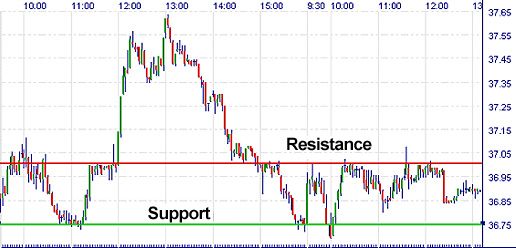
Explaining Stock Market using Behavioral Economics: Level of Resistance and Level of Support. Seriously, how do they work!?? (revised)

**Note1: For those who don't like to read long article, you can skip the first several paragraphs. Scroll down a bit, and jump to the text below the line. I clearly mark it for you. 

**Note2: However, the first several paragraphs do introduce you to a bit of new knowledge as well. If you have time, read them all. 

**Note3: I want to let you know that though I did some research before I wrote, my explanation is purely based on my thinking and the knowledge I have so far. So do not use this as a reference, unless it really convinces you that this article makes a lot of sense. 
------------------------------------------------------------------------------------------------------------------------

I have been thinking of trying to post something new and refreshing to give a bit of breadth to the blog... and voila, there you have it. Today, I was doing some reading, and I came across the terms: "level of resistance" and "level of support" used in trading stock and forex. I do not know if these 2 terms are broadly used in any other types of trading like trading securities in general. That does not matter anyway.

Just a bit of additional info before we start. What are securities? By definition, securities are divided into debt securities and equities. Trading debt securities is none other than trading debt. An example of a debt security would be Bonds, like government and corporate bonds. In contrast, equities represent ownership of assets. Example? Stock, and that is what I am going to talk about today.

Our discussion will be related to stock market, but I am not trying to teach you about how to trade or how to make millions of dollars. If you read this article hoping to make some bucks, then the exit is right there. 

I mean, come on, I, myself, have not even bought or sold any stock once in my life. How can I provide you with the million-dollar tips? Plus, I am a risk-averse person, probably because I have no money, which make any financial loss a huge deal for me. However, I have a decreasing absolute risk aversion trait. What does that mean? That means as I am getting richer, I will become less risk averse, and thus, the amount of wealth I am willing to expose to risk will increase. When that time comes, hopefully, sooner rather than later, I will give it a shot.

Neither am I going to explain you about stock, about stuff like long/short position... okay, may be a bit about the long/short jargon. Nothing much, really. Long means buy. Short means sell. Think of it this way; you have a line of cookies, and when it is getting shorter, then means you have sold some cookies to someone else. By the same token, when it gets longer, that means you have bought some cookies to include in your collection, the long line of cookies in your kitchen. Simple, but not 100% correct. There are more to long/short stock. They are not simply buy and sell, but buy and sell are close enough for the purpose of this article. For more information (if you are curious), please google them.

As you can see, I am not here to teach you Finance 101. I am here to talk about how the level of resistance and level of support are what they are, and why they have been used widely despite the lack of explanation. The thing is I have been going around trying to find a good explanation of why and how those two work, but sadly, I could not find any good sources on the web that provide a clear rationale of what is going on behind the scene (maybe, you can. Give it a try!). I can just imagine the frustration of students trying to digest this knowledge while having little idea of how it works and why it is there.

So, I am going to explain them by myself, using economics or just common sense. There is no secret to it. Things are the way they are because of a reason or two. 

Enough chitchatting, let's get into business.

----------------------------------------------------------------------------------------------------------------------
**The real stuff begins here:

Before we begin, I want to introduce three important elements I am using today to make some sense of the stock shenanigans. (Note: There is not point in using the word "shenanigans" here. It is not even relevant. However, I just think it sounds cool and what to put it somewhere in the text. Try to understand it from the context only, not the exact meaning. lol)

You need to understand three explanatory elements and the definition of the two terms (support and resistance) before we can unravel the mystery. 

First, knowledge of common. What is it? Knowledge of common is common knowledge. I just think it is cooler to use "of". Basically, it is the knowledge shared by either most or all people.

Second, rational expectation. Rational expectation is pretty much what rational people expect to happen as a result of their actions or some uncontrollable exogenous force or shock. Mostly, people use the knowledge they have gained from the various sources such as personal experience, media, books, grapevine and so forth; they then combine the knowledge of the past with the available information of the present to arrive at a final product, the conclusion in the form of expectation, a rational one. Can you see the connection between the first and second elements yet? Get it? People use knowledge to form a rational expectation!

Third, self-fulfilling prophecy. Just a heads up, in case the third element makes you think there is something spiritual about this article, the answer is No. No, There is nothing here for you if you want a fortune-telling. Anyway, self-fulling prophecy is basically a prediction that becomes true because people simply believe the prediction and act accordingly anticipating what foretold to be realized in the future. There are instances in which no matter how ridiculous or baseless the prophecy may sound to the logical thinkers, it can become true with enough people believing in it. That just means being logical is to take this fact into account when engaging in thought. So, can you see how the first, the second, and the third elements are connected yet? People believe in the prophecy (in the form of knowledge), act it out with rational expectation, and the prophecy is actualized!

knowledge of common, rational expectation, and self-fulling prophecy. We will use these three to explain level of resistance and level of support. However, to explain how and why they happen, I need to first clearly define the two financial terminologies.


Image source: http://www.tradingacademy.com/assets/images/fec/supportresistance1.jpg


The picture above will act as an illustration to aid your learning of the concept. They might look simple, but their inherent complexity is undeniable, even to the experienced traders. Let's not make life any harder that it is. There are simple definitions too.

Just like the picture shows, the level of support is a line, a price level, which stock price seems to have difficulty falling below. You will see that the price was pushed down several times, but it could not go lower than the level of support.

On the contrary, level of resistance is the price line, the price ceiling that stock price cannot seem to break through. As you can see in the picture, the price, most of the time, could not increase any further once it reaches the red line, and the fluctuation, most of the time, is within the band of the support line and the resistance line.

This concept is most useful in short-term trading. Why is that? Because short-term trading is influenced more by the profit-seeking behavior of individual traders who do short-term speculation based on their instinct or belief of when and at what point to buy and to sell. Unlike long-term trend, short-term trend is unlikely to be affected by real variables like exogenous (or external) economic shock, new innovation, new products or services, government policies, or any changes in the actual operation of a firm or the whole industry or the business environment. It is based mostly on the animal spirit of the people. That is, by my own definition, what short-term trading is, and this is when level of support and level of resistance work best.

So what does this tell you? It tells you that there are a lot of psychological factors coming into play here, and what I am doing now is using behavioral economics to explain why resistance and support lines exist. (Behavioral economics can be simply regarded as a branch of economics that studies human behaviour and how that influences their individual economic decision and the collective economy)

First of all, we have to understand that short-term traders are always interested in understanding the tools, the concepts to give them the edge in trading. Once level of support and level of resistance have been introduced, once the terms have been coined, people become curious and they study and study to absorb this new knowledge. Sooner or later, the concept becomes a common knowledge for the mass. This particular topic will be everywhere in school, in finance class, and people become more and more acquainted with it, more convinced that support and resistance lines actually work. Once enough people, whether or not they understand the underlying reasons, believe in support and resistance lines, this new knowledge will then become the knowledge of common.

This is when rational expectation comes into play. As you may have guessed, traders are rational people. Well, most profit-seeking individuals are rational. They make rational decision to arrive at a logical conclusion based on what they know, on the information they possess to speculate the future. You will see what I mean by "rational expectation". Keep reading.

Based on the past low stock price and its persistence to fall below that low mark, people start to draw a line and they call it support line. So when a large number of people expect that price will not fall below support line, they will want to buy stock at this point hoping to gain from the imminent increase in price. Voila, now everyone buys stock based on the expectation they form rationally. What does economics tell you? Buy = Demand. People demand more stock at the point of support line, and consequently, the price rises! This pattern repeats itself again and again a few times or many times, leading to what we call "the level of support". In the end, price really does not fall below the support line because people keep buying more stocks pushing the price up as it nearly reaches the support line.

This is what I mean by self-fulling prophecy. Enough people believe that price will not fall below the limit that they draw, they act it out as any rational being would, and due to this reason, price does not fall below the level of support. This further reassures people that level of support does work! So they continue to repeat and the result repeats itself as well.

Same goes for the line of resistance. Same process; knowledge of common and rational expectation lead to self-fulfilling prophecy. Enough people believe that price will not go beyond the resistance line. They start selling when price comes close to the line to gain the maximum profit because they know that price will soon fall. Again, what does economics tell you? Sell = Supply. As people sell their stock, the company's stocks pile up due to sudden increase in supply, and price simply falls as a result.

In the long run, however, stock price will follow the changes in the real-world variables. For instance, just like when Apple announces its new products, and its shareholders start to buy more stock due to their strong faith in the company believing its new products will bring Apple much more success as a company, and thus, a greater return for its shareholders. That is why we see either upward trend or downward trend of a company's stocks. This is one way to break through the support or resistance line.

And that's a wrap. I hope you enjoy reading and ingesting new knowledge just like how I enjoy writing this article. It is just refreshing being able to write something new once in a while.

Until next time,